Integration · Sage 200 and Sage X3
AI quote and order automation for Sage 200 and Sage X3
ERP Agent reads the customer’s enquiry from email, PDF or Excel, identifies the right products in your Sage product records, prices each line from that customer’s price band and creates a sales quote or sales order in Sage 200 or Sage X3 once your rep has approved it. We set up the Sage connection for your company during onboarding.
What ERP Agent reads from Sage 200
On Sage 200 Professional and Sage 200 Standard, the connection runs through the Sage 200 REST API, which signs in with OAuth 2.0 through Sage ID. ERP Agent works from your product records as they are today.
| Data in Sage 200 | Sage 200 API | What ERP Agent does with it |
|---|---|---|
| Products | products | Identifies the right product for every line from the customer’s own wording, and checks each code exists in Sage before anything is written |
| Units of measure | units | Puts each line in a unit Sage uses for buying and selling that product |
| Customers | customers | Finds the customer behind the enquiry, warns the rep when none matches and flags a delivery address that differs from Sage |
| Price bands | price_bands, customer_price_bands | Prices each line from the price band linked to the customer’s account, with the discounts we set up for your company |
Your products, price bands and customer accounts stay exactly as they are: the agent reads them and never changes them.
What ERP Agent writes to Sage 200
Two documents in Sales Order Processing, both written only after a rep has approved the draft.
| Document | Sage 200 API | What is written |
|---|---|---|
| Sales quote | sop_quotes | The customer, the customer’s order reference and every approved line with product, quantity, unit and price from Sage, or the price your rep set in review |
| Sales order | sop_orders | The same lines, plus the requested delivery date and the delivery address taken from the enquiry |
Both are ordinary Sage 200 SOP documents. When a customer accepts a quote, you convert it to a sales order in Sage as usual.
Sage X3: what ERP Agent reads and writes
On Sage X3, the connection uses the X3 GraphQL API, which Sage recommends for real-time integrations, and X3’s SOAP web services, signing in as a connected application with its own X3 user.
| Data in Sage X3 | Through | What ERP Agent does with it |
|---|---|---|
| Products and customer product references | GraphQL: product, customerProduct | Identifies the right product for every line, including the codes your customers use for your products |
| Customers | GraphQL: customer | Finds the customer behind the enquiry and flags a delivery address that differs from X3 |
| Customer prices | Your X3 price lists | Puts the price X3 sets for that customer on every line |
| Sales orders (write) | GraphQL: salesOrder create | Creates the approved sales order with its lines |
| Sales quotes (write) | Quote import (SQH object) through SOAP web services | Creates the approved sales quote with its lines |
Products, price lists and customers are read and never changed; quotes and orders land in X3 as ordinary documents.
Why wholesalers and merchants on Sage add an AI quote agent
The hard part of a quote is not keying it into Sage. It is reading “22mm lever ball valve” or a customer’s own reference and knowing which product that is, which price band applies and which lines need a second look. According to our case study, a sales rep spends on average 4–7 minutes per line when creating quotes and orders by hand; for a 30-line enquiry, that is two to three and a half hours.
ERP Agent does that groundwork. It is the first agentic AI layer for wholesale distribution ERP systems, and on Sage it works on top of the system you already run: no replacement project, and nothing changes for your customers. Customers get answers sooner, and your sales desk spends its time on judgement and selling. Put a number on today’s manual work with the quote cost calculator.
The same agent runs quote automation and order entry automation on any ERP; this page covers what it does inside Sage.
How Sage quote automation works
An enquiry reaches the agent
Reps forward the customer’s email from Outlook to your company’s own agent mailbox, or paste it into the web app as it is and choose quote or sales order. PDF (scanned too), Excel, CSV, Word, images and forwarded emails all work. Your own systems can send enquiries through the REST API or the MCP server.
It finds the customer and the products
The customer is identified from the enquiry and matched in your Sage customer accounts. Abbreviations, dimensions, materials, manufacturer numbers and customer part numbers are mapped to your products, and candidates that contradict a stated size, voltage or rating class are pushed down. An enquiry in one language finds products described in another. A line too vague to identify goes on your placeholder product with the customer’s wording kept, never a guess.
Prices come from Sage
Each line carries the price from the price band or price list Sage applies to that customer. Standard charge lines, such as packing, are added following your rules.
A rep reviews the draft
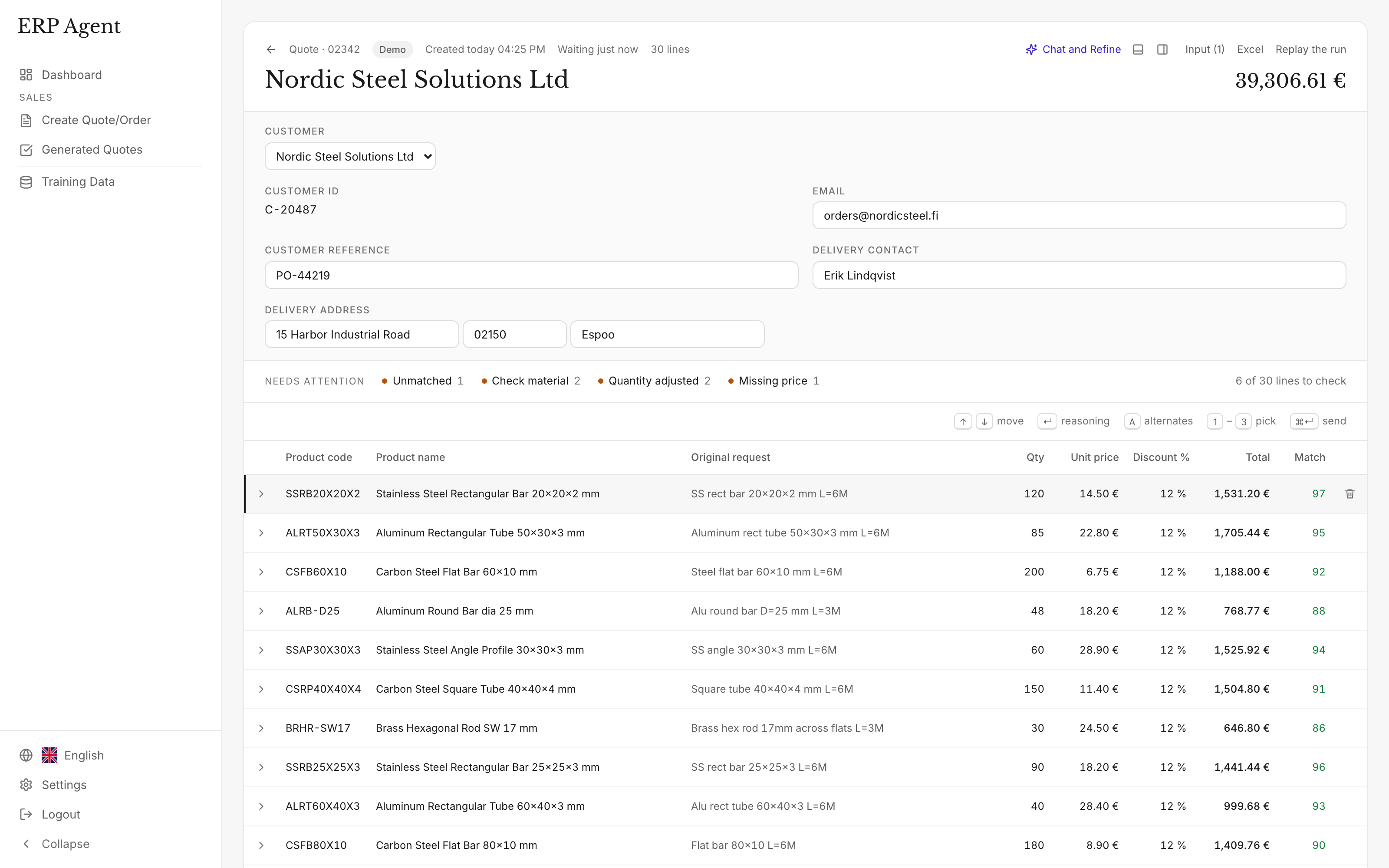
Lines appear in the table as they are matched. The rep checks the marked ones, takes an alternative where needed, makes changes in quote chat and approves.
It is created in Sage
Every product code is checked against Sage first, so a document never carries a code Sage doesn’t know. A short countdown lets the rep cancel. The lines your team sends teach the agent: the next time a customer writes the same thing, it picks the same product.
Example: a plumber’s enquiry becomes a Sage 200 sales quote
A heating engineer emails a list to a plumbing and heating merchant that runs Sage 200. The rep forwards it to the agent mailbox, which is set to create quotes.
“Can you quote the below for the Harrogate job? Delivery to site Tuesday, usual account.”
- 50 x 15mm copper tube 3m
- 40 x 15mm press elbow
- 6 x 22mm lever ball valve
- 10 x TRV 15mm angled
- 24 x your ref PH-5521
- 1 x misc fixings
| Enquiry line | Proposed Sage product | Qty | Match | Note |
|---|---|---|---|---|
| 15mm copper tube 3m | Copper tube EN 1057 R250, 15 mm × 3 m | 50 | 96 | Size and length match. |
| 15mm press elbow | Copper press elbow 90°, 15 mm | 40 | 91 | Solder-ring and compression elbows pushed down. |
| 22mm lever ball valve | Lever ball valve 22 mm, compression, red handle | 6 | 78 | Full-bore and standard-bore versions both fit; marked for review (under 80). |
| TRV 15mm angled | Thermostatic radiator valve, angled, 15 mm | 10 | 93 | Straight versions pushed down. |
| your ref PH-5521 | Pipe clip 15 mm, single, white | 24 | 98 | The customer’s own code, learned from an earlier order. |
| misc fixings | Placeholder product, wording kept | 1 | – | Too vague to identify; the rep decides. |
Illustrative example with sample products, codes and scores. In a real draft each line also carries the price from the customer’s price band in Sage, and the Harrogate site address is flagged because it differs from the customer’s address in Sage.
What the rep sees before anything reaches Sage
- A match score from 0 to 100. Lines under 80 are marked, so review starts where judgement is needed. How the match score works.
- Reasoning. Open a line to see why the agent chose that product.
- Alternatives. Runner-up products are kept for every line; take one instead.
- Quote chat. Add or remove rows or change quantities and prices, then approve or reject each proposed edit line by line.
- Your team stays in control. The rep approves the draft before it is created in Sage, and nothing reaches a customer without approval.
Security and control
- GDPR-compliant, zero data retention. ERP Agent is GDPR-compliant, and models run with zero data retention. More on security and data handling.
- Access agreed first. Before setup, we agree which data the agent needs and which systems it can access.
- Only the access the work needs. On Sage 200, the connection signs in through Sage ID as a user with access to the right company. On Sage X3, it runs as a connected application tied to its own X3 user with only the authorisations the work needs.
- A person approves. Nothing is written to Sage until a rep approves the draft, and nothing reaches a customer without your team.
- Reads, never rewrites. Products, prices and customer accounts are read; the agent creates quotes and orders and changes nothing else.
Onboarding: what we need from you
We set up the Sage connection for your company during onboarding. Your reps don’t wait for it: they start with a catalogue file the same week.
A catalogue export
An export of your products from Sage, for example to Excel or CSV. Reps forward real enquiries from the first week, reviewing every draft in the web app. See starting from a catalogue file.
Sage 200: the API and a Sage ID user
On Sage 200 Professional, you or your Sage business partner enable and configure the API for your site. On either edition, you give a Sage ID user access to the company the agent works in.
Sage X3: a connected application
Your X3 administrator creates a dedicated user with the authorisations we agree, a connected application for ERP Agent and the web service for quote import. We send the exact list.
Your rules and history
Which placeholder product takes lines too vague to identify, which charge lines the agent adds, and past quotes or Outlook email history, so the agent learns how your customers write.
Live in Sage
Customer prices now come from Sage, and approved quotes and orders are created there directly.
ERP Agent in numbers
- 4–7 min
- per line to create quotes and orders by hand, according to our case study
- 95%
- average automation across our customers
- 3–8 min
- for the agent to prepare a typical request
- 1–3 min
- in fast mode, for requests of up to about 50 lines
Sage today, any ERP tomorrow
ERP Agent integrates with Sage, Business Central, SAP, NetSuite and any other ERP or CRM. We set up the connection for your company during onboarding, and you can start with a catalogue file the same week. See Business Central, NetSuite, Odoo and all integrations.
ERP Agent is live with steel, HVAC and fastener distributors. What it checks on each line follows your trade: pipe sizes and fitting types for plumbing and heating merchants, cable sizes and IP ratings for electrical wholesalers, grades and lengths for steel stockholders.
Frequently asked questions
Does ERP Agent work with Sage 200?
Yes, with Sage 200 Professional and Sage 200 Standard. ERP Agent reads products, customers and price bands through the Sage 200 API and creates sales quotes and sales orders in Sales Order Processing after a rep approves. We set up the connection for your company during onboarding, and you can start with a catalogue file the same week.
Does it work with Sage X3?
Yes. ERP Agent reads products, customer product references and customers through the X3 GraphQL API, creates sales orders there and creates sales quotes through X3’s quote import. We set up the connection during onboarding.
Does it create sales quotes or sales orders in Sage?
Both. In the web app the rep chooses quote or sales order for each enquiry; emails forwarded to the agent mailbox become the document type your company has chosen. For customer purchase orders arriving by email, see purchase order to sales order automation.
Does ERP Agent replace Sage Copilot?
No, it adds a dedicated quote and order agent alongside it. Sage Copilot is Sage’s AI assistant for questions about your business data. ERP Agent does the sales desk’s work: it identifies the right products from customers’ shorthand and own codes in enquiries of several hundred lines, scores every line from 0 to 100 with its reasoning and alternatives, matches across languages and learns from the lines your team sends.
What does ERP Agent need access to in Sage?
Read access to products, units, customers and pricing, and permission to create sales quotes and sales orders: through a Sage ID user on Sage 200, through a connected application and a dedicated user on Sage X3. We agree the scope with you before setup.
Which Sage products does it work with?
Sage 200 Professional and Sage 200 Standard through the Sage 200 API, and Sage X3 through its GraphQL API and SOAP web services. On another Sage product, such as Sage 50, we agree the route during onboarding.
How do we get started?
Book a call and bring a few real enquiries. You start with a catalogue file the same week, and we set up the Sage connection during onboarding. Pricing is a setup fee plus a monthly subscription, with an itemised quote before you start. See pricing.
Related
- AI quote automation for distributors and wholesalers
- Order entry automation for distributors: customer POs to sales orders
- ERP integrations for AI quote and order automation, on any ERP system
- AI quote and order automation for Business Central
- AI quote and order automation for NetSuite
- Plumbing supply quote automation for merchants and PVF distributors
Let’s look at your quote workflow
Bring an enquiry from your inbox
Book a 30-minute call with a few real enquiries; we’ll show how the agent handles them with your products and what connecting your Sage involves.
- Your requests and product catalogue
- Your pricing and review process
- A clear scope for the next step

Lauri Pelkonen
Founder & CEO
Book a 30-minute call Request a demo by emailOr use the address directly