Steel distribution
Steel distribution quote automation for stockholders and metal service centres
Steel distribution quote automation turns a customer’s enquiry (a cutting list, a spreadsheet of sections, a two-line email from site) into a draft quote from your own catalogue. ERP Agent identifies the right section, size and grade, converts lengths into kilograms, metres or pieces, whichever you sell in, adds a sawing line for non-standard cuts and brings in customer pricing. Your team reviews and sends.
What does a steel enquiry look like?
A fabricator emails a cutting list as a PDF. A contractor sends a spreadsheet of beams and hollow sections. A regular customer types “SHS 100x100x5 S355 x4, flat 100x10 6 off @ 2350” from site.
Each line has to become one of your items, chosen from variants that differ by a millimetre of wall, a grade (S275 or S355, 304 or 316) or a finish. Then the quantity goes into your selling unit: the customer writes pieces and lengths, you sell by the kilo or the metre, and a cut means a sawing charge. According to our case study, a sales rep spends on average 4–7 minutes per line when creating quotes and orders by hand. At that rate, a 30-line cutting list takes two to three and a half hours, while the fabricator waits for your price, often with the same list out to other stockholders.
How does steel distribution quote automation work?
The enquiry arrives
A rep forwards the email to your agent mailbox or pastes it into the web app. The agent reads the body and attachments: PDF (scanned too), Excel, CSV, Word and images; see email to ERP.
Lines to products
Wording your team has confirmed before, customer codes included, goes to the same item again; other lines are matched by section, size, grade and description, across languages. The numbers on the line, such as 100x100x5 or Ø40, tell size variants apart, and a second check you can switch on sends wrong matches back before you see them.
Units and cutting
Quantities go into the unit your ERP sells the item in, using the weight per metre and standard lengths in your product data (such as L=6000). A total in metres stays a total. For items sold by weight or by the metre, a cut that is not a standard length adds a line on your sawing service code, and a saw allowance per cut, if you use one, goes into the weight.
Pricing, review and send
Customer pricing comes from your company’s own data and rules. A line the agent cannot place goes on your placeholder code instead of a guess, so nothing slips through unchecked. A rep approves, and the quote or sales order is written to your ERP, CRM or other system.
Example: a fabricator’s cutting list, line by line
Prices are left out. In this example, SHS, flat and round bar sell by the kilo, RHS by the metre and CHS by the length.
Email from a fabricator: “Can you price this for Thursday?”
- SHS 100x100x5 S355 – 4 x 6m lengths
- Flat 100x10 S275, 6 off @ 2350
- RHS 120x80x5 – 18m total
- EN8 round 40mm, 120kg cut to 469mm
- CHS 48.3 x 4.0 – 10 lengths
- Floor grating for the platform x 4 – sizes to follow
| Request line | Proposed product | Offered | Score | Why |
|---|---|---|---|---|
| SHS | 210105 SHS 100x100x5 S355J2H, 6 m | 352.8 kg | 96 | 4 × 6 m × 14.7 kg/m; standard length |
| Flat bar | 330110 Flat bar 100x10 S275JR | 110.69 kg | 95 | 6 × 2.35 m × 7.85 kg/m |
| (added) | 900010 Sawing service | 6 pcs | 100 | 2350 mm is not standard |
| RHS | 220812 RHS 120x80x5 S355J2H | 18 m | 94 | A total, not a cut |
| Round bar | 410040 Bright round bar 40 mm 080M40 (EN8) | 120 kg | 91 | Weight kept as ordered |
| (added) | 900010 Sawing service | 26 pcs | 100 | Worked out from 120 kg at 469 mm |
| CHS | 230483 CHS 48.3x4.0 S355J2H hot-finished | 10 pcs | 74 | Cold-formed offered as the alternative; marked for review |
| Grating | Placeholder code | 4 | 0 | Sizes to follow; held for the rep instead of a guess |
Illustrative example: the enquiry, product codes and scores are invented. Weights per metre are typical; real drafts use your product data.
What your sales team sees before anything is sent
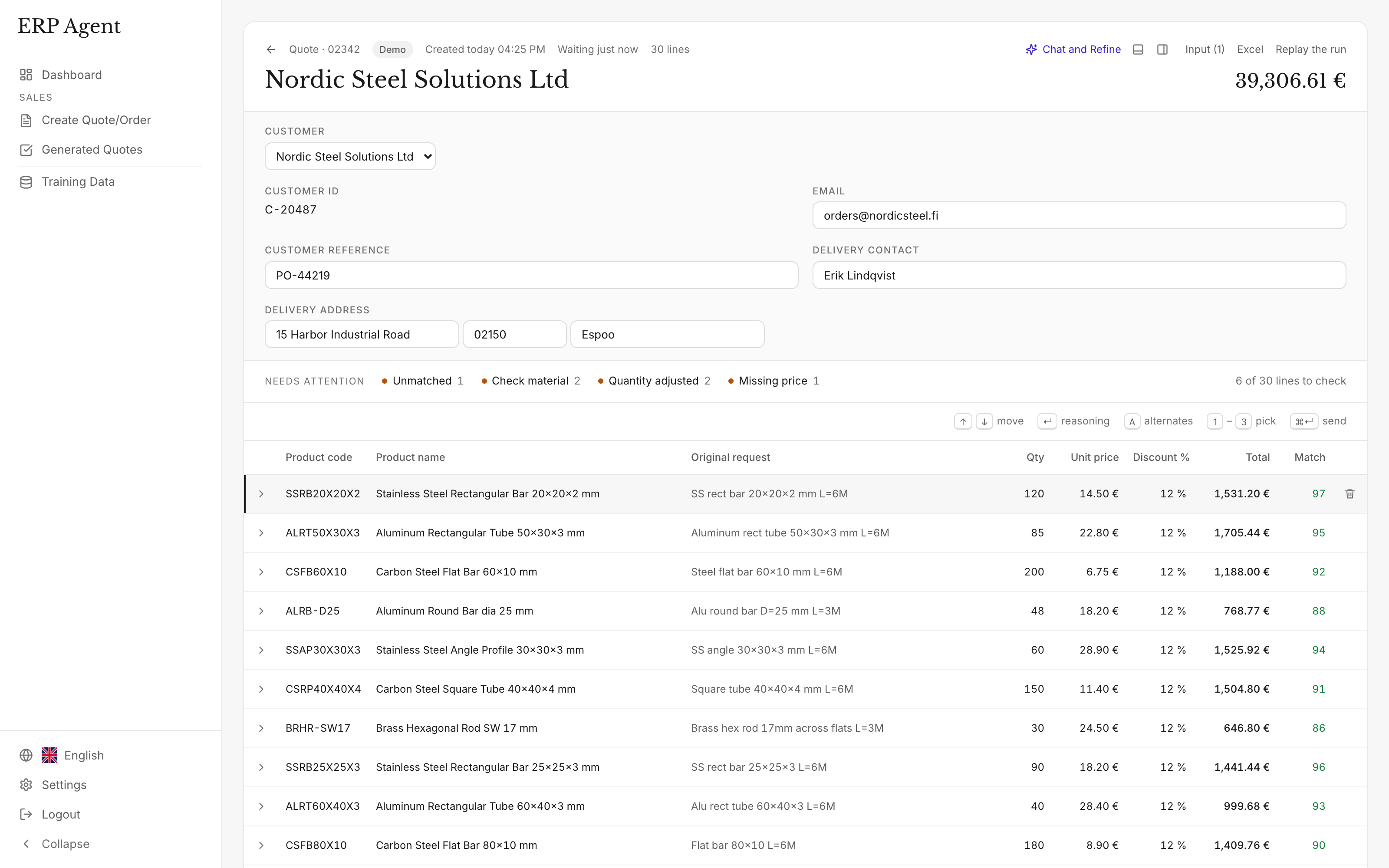
- The customer’s line next to the proposed product, so the rep checks instead of searching.
- Every conversion explained: open a line to read how the quantity was worked out, such as 6 × 2.35 m × 7.85 kg/m.
- A match score from 0 to 100; lines under 80 are marked. See how the match score works.
- Reasoning and alternatives: read why the agent chose an item, or take a runner-up such as the cold-formed tube.
- Quote chat: add or remove rows, change quantities or prices; you approve or reject each proposed edit.
- A person approves. The agent sends nothing on its own, and product codes are checked against the ERP first.
Steel stockholder quoting in the UK, metal service center quoting in the US
Steel stockholder quoting AI has to read enquiries the way UK customers write them: metric sections, grades written as S275 or S355J2H, EN8 or 316L, quantities as “off”, “no.” or “lengths”, and much of the work cut to length. ERP Agent turns each of those lines into your item, your selling unit and, where a cut is needed, a sawing line, so the stockholder’s team only checks the draft.
In metal service center quote automation, customers write ASTM grades and imperial sizes: A36 plate, A500 tube, wide-flange beams. The agent reads them as written and identifies the matching items in your own catalogue, with the customer’s wording, a match score and the agent’s reasoning on every line. Size variants are told apart by the numbers on the line, and the item your team confirms once is the one the agent picks next time.
Supplier confirmations
ERP Agent also works on the buying side. It compares supplier order confirmations with your purchase order line by line.
Where the quote lands
ERP Agent integrates with Business Central, SAP, NetSuite, Visma, IFS, Sage and any other ERP or CRM, and creates the quote or sales order there with customer prices and discounts from your ERP’s own price logic. We set up the connection for your company during onboarding, and you can start with a catalogue file the same week. Unit conversion and sawing lines run on the weights per metre and standard lengths in your own product data.
| System | Type | Reads | Writes |
|---|---|---|---|
| Dynamics 365 Business Central | ERP integration | Items, customers, customer prices | Sales quotes and sales orders |
| SAP S/4HANA | ERP integration | Products, business partners, customer prices | Sales quotations and sales orders |
| SAP Business One | ERP integration | Items, business partners, price lists | Sales quotations and sales orders |
| NetSuite | ERP integration | Items, customers, customer prices | Estimates (quotes) and sales orders |
| Dynamics 365 Finance & Supply Chain | ERP integration | Released products, customers, trade agreement prices | Sales quotations and sales orders |
| Visma | ERP integration | Items, customers, customer prices | Quotes and sales orders |
| IFS | ERP integration | Sales parts, customers, customer prices | Sales quotations and customer orders |
| Monitor ERP | ERP integration | Parts, customers, customer prices | Quotes and customer orders |
| Infor M3 | ERP integration | Items, customers, customer prices | Quotations and customer orders |
| Exact | ERP integration | Items, customers, sales prices | Quotations and sales orders |
| AFAS Profit | ERP integration | Items, debtors, price agreements | Quotes and sales orders |
| Odoo | ERP integration | Products, customers, pricelists | Quotations and sales orders |
| Sage | ERP integration | Items, customers, customer prices | Sales quotes and sales orders |
| Jeeves | ERP integration | Items, customers, customer prices | Quotes and sales orders; confirmed values on purchase orders |
| Lemonsoft | ERP integration | Items, customers, customer prices | Quotes |
| Microsoft 365 / Outlook | Email integration | Customer requests in the agent mailbox; email history for training | Nothing is sent to customers without your team |
| Catalogue file / SFTP | File | Product catalogue from a file, from the first week | The reviewed quote or order as a file, ready to import into your system |
| Any other ERP or CRM | ERP or CRM integration | Products, customers and prices, through the connection we set up for your company during onboarding | Quotes and sales orders |
Built around how a steel distributor already works
- Works on top of your ERP, with no replacement project. Your item master, weights per metre, standard lengths and price logic stay where they are, and the agent works from them.
- Your prices, your rules. Customer pricing comes from your ERP and the rules set for your company, and reps can edit every price before the quote goes out.
- Your team stays in control. Nothing reaches a customer without a person’s approval, and every line shows its score and reasoning.
- Start with a catalogue file; connect your ERP when you’re ready. Reps can forward real cutting lists to the agent mailbox while the connection is built.
- It learns from every line your team sends. The next time a fabricator writes the same thing, the agent picks the same product.
ERP Agent in numbers
- Live
- with steel, HVAC and fastener distributors
- 4–7 min
- per line when a sales rep creates quotes and orders by hand, according to our case study
- Over 95%
- average automation across our customers
- Over 95%
- accuracy in quote-line automation at LVI-WaBeK
- 0–100
- match score on every line; under 80 is marked for review
How can a steel distributor start using AI for quoting?
Useful AI quote automation for a steel distributor works on your own catalogue, weights and pricing, and learns from every line your team sends. New reps start from what colleagues have confirmed, experienced reps get time back for customers, and fabricators get prices back sooner.
Start with your slowest cutting lists. A pilot runs on your own catalogue and past quotes, and reps forward real enquiries to the agent mailbox while the ERP connection is built. At LVI-WaBeK, ERP Agent automates quote lines with over 95% accuracy. Plan your test with the AI quote agent pilot checklist, and price a manual line with the quote cost calculator.
Frequently asked questions
What is steel distribution quote automation?
Software that turns a customer’s enquiry into a draft quote from your own catalogue: items matched by section, size and grade, quantities in your selling unit, cutting added, customer pricing applied. A rep reviews the draft before it lands in your ERP, CRM or other system.
Can it convert lengths into kilograms, metres or pieces?
Yes. Pieces and cut lengths are multiplied by the weight per metre in your product data when you sell by weight, added up to metres when you sell by length, and kept as pieces otherwise; metres of an item sold by the piece become whole lengths. Each line’s reasoning shows the calculation.
Does it add a sawing charge for cut-to-length orders?
Yes: for items sold by weight or by the metre, a line on your sawing service code, with the number of pieces to cut, whenever the cut length differs from the standard lengths in your product data. Full lengths get none, and the rep can edit or remove the line.
Does this steel distributor quoting software work with our ERP?
Yes. ERP Agent integrates with Business Central, SAP, NetSuite, Visma, IFS, Sage and any other ERP or CRM, with prices from your ERP’s own price logic, customer discounts included. We set up the connection for your company during onboarding, and you can start with a catalogue file the same week. See ERP and email integrations.
Where do the prices in a steel quote come from?
From your own pricing. The agent brings in customer prices from the data and rules configured for your company; once your ERP is connected, that is the ERP’s own price logic, customer discounts included. Reps review every price and can change any of them before sending.
How long does a long cutting list take?
A typical request takes 3–8 minutes; a request of several hundred lines about half an hour. Fast mode handles requests of up to about 50 lines in 1–3 minutes. A large run starts once a user approves it.
Related
- AI quote automation for distributors and wholesalers
- RFQ automation for distributors and industrial suppliers
- Order entry automation for distributors: customer POs to sales orders
- Purchase order to sales order automation for wholesale distributors
- Supplier order confirmation automation, line by line against the PO
- Fastener quoting software: from customer shorthand to a reviewed quote
Let’s look at your quote workflow
Bring a real cutting list
Book a 30-minute call and bring a steel enquiry your team found slow to quote.
- Your requests and product catalogue
- Your pricing and review process
- A clear scope for the next step

Lauri Pelkonen
Founder & CEO
Book a 30-minute call Request a demo by emailOr use the address directly