Exported from a purchasing system
PDF or Excel in a fixed layout, in the buyer’s material numbers. The agent learns from the lines your team sends, so the next PO with the same number gets the same product.
Use case · Customer purchase orders
Purchase order to sales order automation turns the purchase orders your customers send by email, as PDF, Excel, Word or plain text, into sales orders without re-keying. ERP Agent identifies the customer and the right products in your own catalogue from the buyer’s part numbers and wording, brings in customer pricing and marks the lines worth a second look. Your team approves, and the order lands in your ERP, CRM or other system.
A customer PO rarely arrives in a form your ERP can take. It is written in the buyer’s part numbers, descriptions and units, not yours.
So someone on the sales desk re-keys it: customer account, delivery address, which catalogue item each line means, price, quantity. According to our case study, a sales rep spends on average 4–7 minutes per line when creating quotes and orders by hand. That is selling time spent typing while the customer waits.
ERP Agent takes that groundwork off the sales desk. Customers hear back sooner, reps spend their time on judgement and selling, and new starters are productive without first memorising every customer’s part numbers.
This page covers purchase orders you receive. For order intake in general, see AI order entry for distributors and email to ERP; for the POs you send to suppliers, see supplier order confirmations.
For definitions and the order of documents, see purchase order vs sales order and quote to order.
| On the customer’s purchase order | On your sales order | |
|---|---|---|
| Customer | The buyer’s company name, rarely your account number | Your customer account |
| Delivery address | As typed, sometimes without a postcode | A complete address |
| Item codes | The buyer’s material numbers and wording | Your catalogue codes |
| Units | The buyer’s units: EA, PAC, metres, lengths | Your selling units and pack sizes |
| Prices | Often none, or what the buyer expects to pay | The customer’s price from your price rules |
Reps forward the PO from Outlook or any mail client to your company’s own agent mailbox (Microsoft 365 / Outlook), or drop it into the web app as it is and pick sales order as the document type. Your own systems can use the REST API or MCP server.
Email text and attachments: PDF (including scanned PDFs), Excel, CSV, Word, images and forwarded emails.
It looks the customer up in your customer register and alerts the rep when there is no match. It tidies the delivery address, fills in a missing postcode and flags an address that differs from the one in your ERP.
Each line is matched to your catalogue from part numbers, the customer’s own codes, abbreviations, dimensions and descriptions, even when the PO is in a different language from your catalogue. Steel lengths and weights are converted to kg, metres or pieces. A line too vague to identify goes on your placeholder code with the buyer’s wording kept, never a guess. You can also switch on a second check that reviews each matched line and sends wrong matches back.
Prices come from the data and rules configured for your company. Your team can review and edit any price.
The rep checks the draft and approves it. Product codes are checked against the ERP before anything is saved, so no order goes in with a code your ERP does not know. Once your ERP is connected, the approved order is created there as a sales order directly.
A control-panel builder emails an Excel PO exported from its purchasing system, written in its own material numbers. The draft before review:
PO 4510-0092.xlsx · Northfield Controls Ltd · Deliver to: Unit 7, Marsh Lane, Hull
| PO line | Proposed | Qty | Score |
|---|---|---|---|
| Header | Northfield Controls Ltd found in your customer register; missing delivery postcode filled in | – | – |
| 10 · 300-11872 | Contactor 3-pole 18 A, 24 V DC coil; 230 V AC coil versions pushed down | 6 pcs | 95 |
| 20 · 300-11904 | Miniature circuit breaker 2-pole C16, 6 kA | 20 pcs | 96 |
| 30 · 300-12260 | Cable gland M20 x 1.5, IP68, polyamide, black, pack of 100 | 2 packs | 91 |
| 40 · 300-12733 | Screw terminal block 4 mm², grey (alternative: the push-in version) | 40 pcs | 74 marked |
Illustrative example: the customer, codes, products and scores are fictional. Line 40 is marked because the PO does not say screw or push-in, so the rep picks one in a click.
Yes. Exported PDFs, scans, spreadsheets and email text all go through the same steps, and reading the text is the easy part.
A converter that only extracts text hands you the buyer’s descriptions in neat fields and leaves the hard step to your team: which of your products each line means, at which price. Template-based capture also needs a template for every customer’s PO layout. ERP Agent identifies the products from the customer’s own words and part numbers, so there is nothing to map: a new customer’s very first PO is matched straight against your catalogue, with no setup for that customer.
That includes customer part numbers, and competitor codes mapped through your cross-reference data, with the customer’s code shown on the line.
PDF or Excel in a fixed layout, in the buyer’s material numbers. The agent learns from the lines your team sends, so the next PO with the same number gets the same product.
A signed PO scanned to PDF, or a photo of one, is read with OCR and matched line by line like any other order.
Order lines in the email body, no attachment. Reps forward or paste it as it is; there is nothing to tidy up first.
A Swedish or German PO against an English catalogue: the agent identifies the right products across languages.
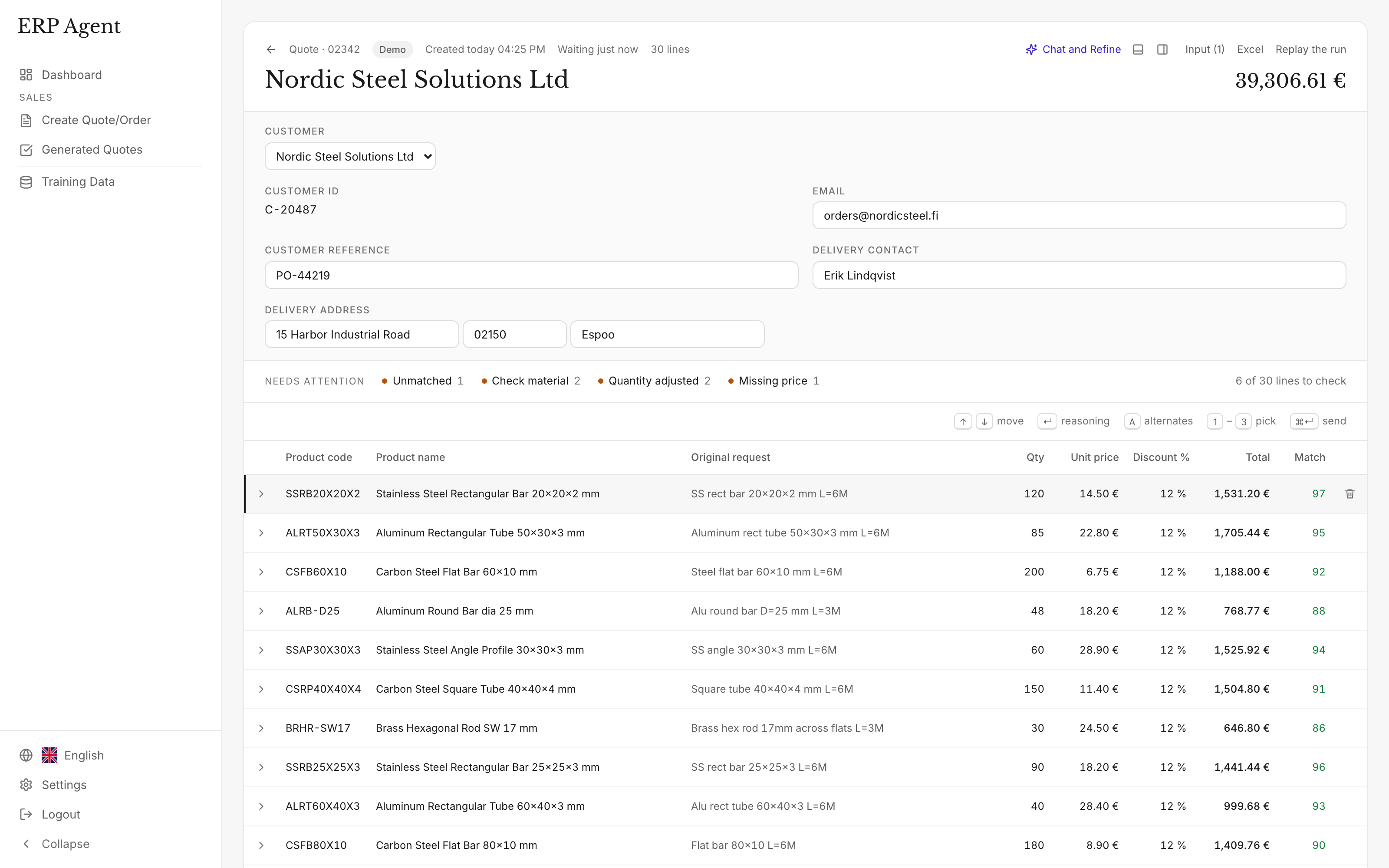
ERP Agent is an AI agent that shows how sure it is: every line carries a match score from 0 to 100, and lines under 80 are marked, so review starts where judgement is needed. Open a line to read the agent’s reasoning or take an alternative product. The PO’s original wording stays next to each match.
Changes go through chat: add or remove rows, change quantities or prices, and approve or reject each proposed edit line by line.
ERP Agent is the first agentic AI layer for wholesale distribution ERP systems. For customer purchase orders, that means:
ERP Agent integrates with Business Central, SAP, NetSuite, Visma, IFS, Sage and any other ERP or CRM. We set up the connection for your company during onboarding, and the approved PO is then created as a sales order in your ERP directly. Until then, start with a catalogue file the same week: the reviewed order comes out as a file ready to import.
| System | Type | Reads | Writes |
|---|---|---|---|
| Dynamics 365 Business Central | ERP integration | Items, customers, customer prices | Sales quotes and sales orders |
| SAP S/4HANA | ERP integration | Products, business partners, customer prices | Sales quotations and sales orders |
| SAP Business One | ERP integration | Items, business partners, price lists | Sales quotations and sales orders |
| NetSuite | ERP integration | Items, customers, customer prices | Estimates (quotes) and sales orders |
| Dynamics 365 Finance & Supply Chain | ERP integration | Released products, customers, trade agreement prices | Sales quotations and sales orders |
| Visma | ERP integration | Items, customers, customer prices | Quotes and sales orders |
| IFS | ERP integration | Sales parts, customers, customer prices | Sales quotations and customer orders |
| Monitor ERP | ERP integration | Parts, customers, customer prices | Quotes and customer orders |
| Infor M3 | ERP integration | Items, customers, customer prices | Quotations and customer orders |
| Exact | ERP integration | Items, customers, sales prices | Quotations and sales orders |
| AFAS Profit | ERP integration | Items, debtors, price agreements | Quotes and sales orders |
| Odoo | ERP integration | Products, customers, pricelists | Quotations and sales orders |
| Sage | ERP integration | Items, customers, customer prices | Sales quotes and sales orders |
| Jeeves | ERP integration | Items, customers, customer prices | Quotes and sales orders; confirmed values on purchase orders |
| Lemonsoft | ERP integration | Items, customers, customer prices | Quotes |
| Microsoft 365 / Outlook | Email integration | Customer requests in the agent mailbox; email history for training | Nothing is sent to customers without your team |
| Catalogue file / SFTP | File | Product catalogue from a file, from the first week | The reviewed quote or order as a file, ready to import into your system |
| Any other ERP or CRM | ERP or CRM integration | Products, customers and prices, through the connection we set up for your company during onboarding | Quotes and sales orders |
ERP Agent is live with steel, HVAC and fastener distributors. By trade: steel distribution, HVAC wholesale, fastener distributors and electrical wholesale. For the quote side of the same work, read the LVI-WaBeK customer story.
Start with a catalogue file the same week: we load your catalogue, reps forward real POs to the agent mailbox or drop them into the web app from day one, and the ERP connection follows. Past orders and sales history help the agent learn your customers’ part numbers and what they usually buy.
Before setup, we agree which data the agent needs and which systems it can access. ERP Agent is GDPR-compliant, and models run with zero data retention.
Test it on POs your team has already entered with the AI quote agent pilot checklist, which covers sales orders too.
Pricing is a setup fee plus a monthly subscription, with an itemised quote before you start (pricing). Put a figure on re-keying with the quote and order cost calculator. Moving off a template-based order capture tool? ERP Agent needs no template per customer layout, so there is nothing to map when you switch.
The purchase order. Your customer issues it to buy from you, and you create a sales order in response. If you quoted first, the sequence is enquiry, quote, purchase order, sales order, delivery and invoice.
Yes. Reps forward the email, attachments included, to your company’s agent mailbox. ERP Agent identifies the customer and the right products in your catalogue, brings in pricing and prepares a sales order draft, which your team approves before it is written to your ERP, CRM or other system.
Yes. It reads exported and scanned PDFs, identifies the right products from the buyer’s part numbers and wording and prepares a sales order draft. Your team approves it, and the order lands in your ERP, CRM or other system.
Yes. ERP Agent integrates with Business Central, SAP, NetSuite, Visma, IFS, Sage and any other ERP or CRM. We set up the connection for your company during onboarding, and you can start with a catalogue file the same week. See the integrations overview.
Yes. ERP Agent maps the buyer’s material numbers and article codes to your catalogue, shows the customer’s code on the line and learns from each order your team sends, so the next PO with the same number gets the same product. See customer part numbers.
The agent does not guess. The line goes on your placeholder code with the customer’s wording beside it, and the rep picks the product in the review screen. Once the order is sent, the agent learns the pair for next time.
No. Your team approves the draft before it is written to your ERP, CRM or other system, and the agent cannot send anything to customers on its own.
A typical order takes the agent 3–8 minutes; by hand, according to our case study, a sales rep spends 4–7 minutes on every line. An order of several hundred lines takes about half an hour, and fast mode handles orders of up to about 50 lines in 1–3 minutes.
Let’s look at your quote workflow
Book a call with a few recent POs to hand, and we will go through how they would become sales orders in your setup.

Founder & CEO
Book a 30-minute call Request a demo by emailOr use the address directly