Fasteners and fixings
DIN codes, sizes and property classes tell variants apart, such as a DIN 933 set screw from a DIN 931 bolt, and the customer's wording stays next to every proposed product. AI for fastener distributors.
AI order entry
Order entry automation for distributors turns a customer's purchase order, whether it arrives as an email, PDF or Excel file, into a sales order with the right products from your own catalogue and the customer's prices. ERP Agent prepares the draft, your team checks it line by line, and the approved order goes to your ERP, CRM or other system.
Many customer orders still reach a wholesaler or merchant by email: a PDF purchase order from the buyer's procurement system with their own part numbers, an Excel list, a scanned PO, or 'same as last time, plus 50 of the M12 anchors'.
Someone in internal sales then reads each line, works out which product in your catalogue is meant, checks the unit and the customer's price, and keys the sales order into the ERP. According to our case study, a sales rep spends on average 4–7 minutes per line creating quotes and orders by hand: two to three and a half hours for an example order of 30 lines.
The slow part is not reading the document. It is knowing that 'nyloc M10 A2' is your nylon insert lock nut in stainless: knowledge that sits with your experienced people and is slow to pass on to new starters. ERP Agent puts that knowledge to work on every order, so customers get their confirmation sooner and your reps get time back for selling.
This page covers the orders your customers send you. For the customer-PO step on its own, see purchase order to sales order automation. On the buying side, ERP Agent checks supplier order confirmations against your purchase orders. Unsure which document is which? See purchase order vs sales order.
AI sales order processing with ERP Agent, step by step:
Your team forwards the customer's email to your company's agent mailbox, or pastes it into the web app as it is and picks sales order as the document type. Other systems can send orders through the REST API or MCP server. See email to ERP automation.
The agent reads the email and its attachments (PDF, scanned PDFs included, Excel, CSV, Word and images). It finds the customer in your ERP's customer register, warns you when none matches, and flags a delivery address that differs from the ERP's.
Lines are matched to your own catalogue from abbreviations, dimensions, materials and part numbers, the customer's own included, even when the order is written in a different language from your catalogue. Products that contradict a stated size, voltage or rating class are pushed down, and a second check you can switch on sends wrong matches back for another search.
Prices come from the data and rules configured for your company. Once your ERP is connected, they come from its own price logic, customer-specific prices included. Your team can edit any price.
Your team reviews and approves the draft. Product codes are checked against the ERP before anything is saved, so an order never reaches it with a code that doesn't exist there. The approved order becomes a sales order in your ERP.
A mechanical contractor emails a PDF purchase order to a fixings distributor.
Customer PO, PDF attached to an email: 'Please supply for Thursday, deliver to site'
| Line | Proposed product | Qty | Match | Note |
|---|---|---|---|---|
| 1 | Hexagon head bolt M10 × 40, A2 stainless | 200 | 86 | In UK usage a bolt is part-threaded; if full thread was meant, take the set screw alternative. |
| 2 | Nylon insert lock nut M10, A2 stainless | 200 | 97 | As written. |
| 3 | Flat washer Form A M10, A2 stainless | 400 | 94 | 'st/st' read as stainless. |
| 4 | Threaded rod M10 × 1 m, A2 stainless | 25 | 99 | The customer's own code; your team sent this product for it before. |
| 5 | Through bolt M12 × 100, zinc plated | 50 | 72 | Marked for review (under 80): length not stated. Proposed from this customer's sales history. |
Illustrative example with fictional data, showing how a draft is laid out.
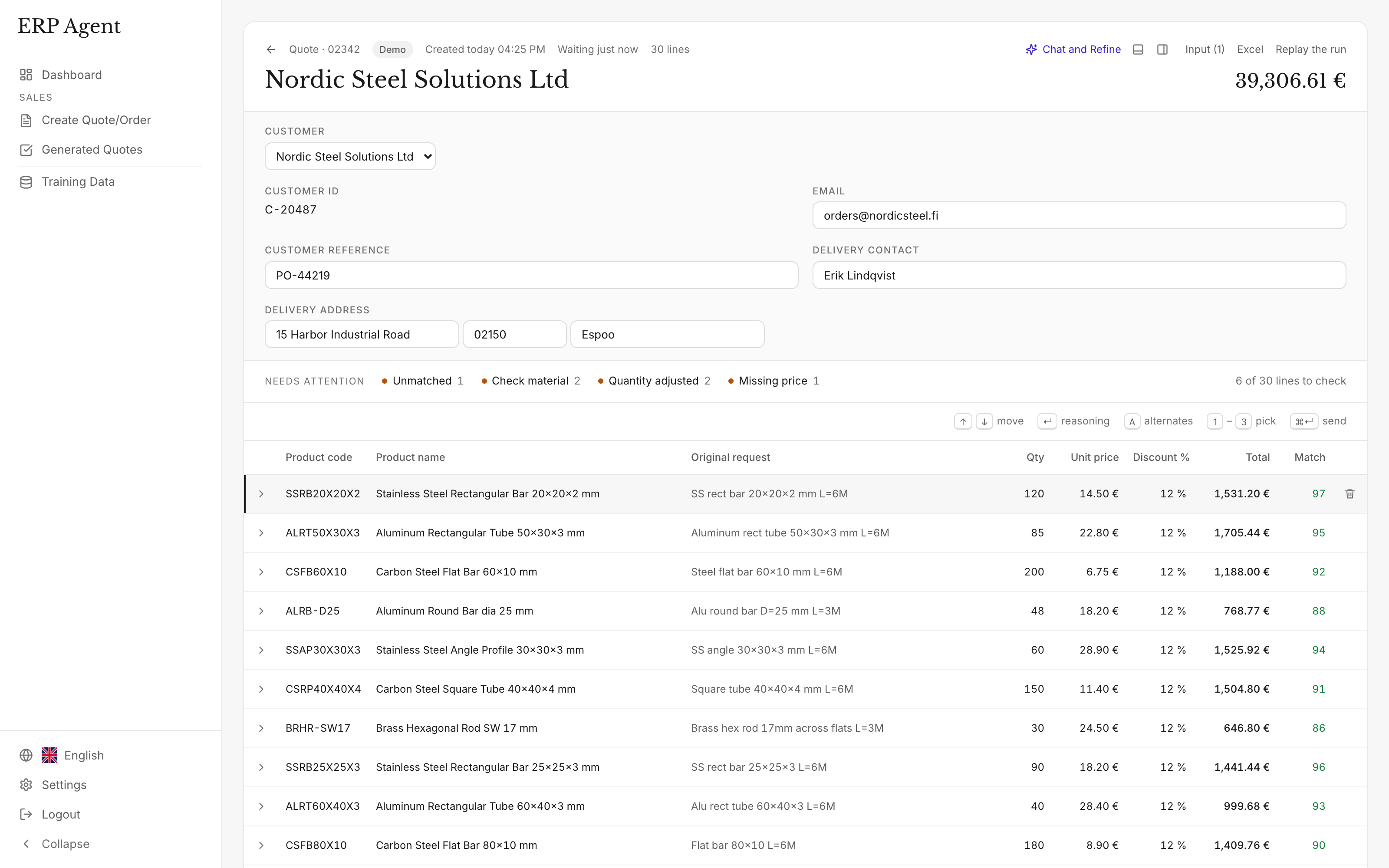
Everything the reviewer needs sits on the line:
ERP Agent works on top of the systems you already run.
| Connection | Reads | What ERP Agent creates |
|---|---|---|
| Business Central | Items, customers, customer prices | Sales orders and sales quotes, directly in Business Central |
| SAP S/4HANA and SAP Business One | Products, business partners, customer prices | Sales orders and sales quotations, directly in SAP |
| NetSuite | Items, customers, customer pricing | Sales orders and estimates, directly in NetSuite |
| Visma, IFS, Sage, Jeeves | Products, customers, customer pricing | Sales orders and quotes, directly in your ERP |
| Catalogue file / SFTP | Product catalogue from a file | The reviewed order as a file, ready to import: start the same week |
| Microsoft 365 / Outlook | Customer orders in the agent mailbox | Nothing is sent to customers without your team |
| Any other ERP or CRM | Products, customers and prices, through the connection we set up during onboarding | Sales orders and quotes in your ERP, CRM or other system |
ERP Agent integrates with Business Central, SAP, NetSuite, Visma, IFS, Sage and any other ERP or CRM. We set up the connection for your company during onboarding, and you can start with a catalogue file the same week. See all ERP integrations.
OCR and template-based capture tools turn a PDF into fields. That removes the typing, but the line still says 'nyloc M10 A2', and someone still has to find the product, the unit and the price. Template-based capture also needs a layout set up for every customer format. ERP Agent identifies the products from the customer's own words, so there is nothing to map: a customer who orders for the first time is handled like your largest account.
EDI works for large accounts that already send your product codes, and it keeps running as it is. The orders it never reaches are the ones smaller customers write by email in their own words. That is where ERP Agent does the work: the right product and price for each line, with a score that shows how sure it is.
Evaluating other tools? Test ERP Agent on orders your team has already entered, using the pilot checklist, and compare its drafts line by line with what was sent.
ERP Agent is live with steel, HVAC and fastener distributors.
DIN codes, sizes and property classes tell variants apart, such as a DIN 933 set screw from a DIN 931 bolt, and the customer's wording stays next to every proposed product. AI for fastener distributors.
Lengths converted to kg, metres or pieces, with a cutting line when needed. AI for steel distribution.
Sizes such as Ø250 or 600x300 and fire ratings such as EI60 are checked on every line, and products that contradict them are pushed down. AI for HVAC wholesalers.
When a line says 24 V, products rated 230 V are pushed down. AI for electrical wholesalers.
At LVI-WaBeK, a building services wholesaler, ERP Agent automates quote lines with over 95% accuracy. The result: more time for customer relationships. Read the LVI-WaBeK story.
Reps can start before the ERP connection exists: they forward orders to the agent mailbox and review the drafts in the web app, and the connection follows. Your product catalogue is all the agent needs to begin; past quotes and sales history help it learn how your customers write and what they usually buy.
Before setup, we agree which data the agent needs and which systems it can access. Models run with zero data retention, and the service is GDPR-compliant. See pricing, security and data handling and the quote-line cost calculator.
Yes, the part that takes the time: reading the order as it arrives, identifying which of your products each line means, bringing in the customer's price and preparing the sales order. With ERP Agent, unclear lines are marked and a person approves before anything is written to your ERP, CRM or other system.
Sales order automation means creating sales orders in your ERP, CRM or other system from incoming customer orders without keying each line by hand. For a distributor, the hard step is turning the customer's wording into your product codes and prices, and that is the step ERP Agent is built for. See what order entry means.
ERP Agent integrates with Business Central, SAP, NetSuite, Visma, IFS, Sage and any other ERP or CRM, and the approved order is created as a sales order directly in your ERP. We set up the connection for your company during onboarding, and you can start with a catalogue file the same week. See ERP integrations.
Email bodies and attachments: PDF (scanned PDFs included), Excel, CSV, Word, images and forwarded emails. Orders can also be pasted into the web app or sent by another system through the REST API or the MCP server. No template is needed for any customer's layout.
The agent never forces a match: it puts the line on your organisation's placeholder code with the customer's wording kept, and lines scoring under 80 are marked. Your team picks the product, takes an alternative or asks the agent in chat.
A typical request takes 3–8 minutes, and one of several hundred lines about half an hour. Fast mode handles requests of up to about 50 lines in 1–3 minutes, and lines appear in the review table as they are matched.
Yes, once they are in your data or your team has used them. The customer's code is shown on the line, and after your team sends a product for a code, the agent picks the same product next time. See customer part number cross-reference.
Your team. By default, a person reviews before anything is written to the ERP, CRM or other system, and a short countdown after approval lets the rep cancel the send. The agent cannot send anything to a customer on its own.
Pricing consists of a setup fee and a monthly subscription. The setup scope depends on integrations, product data and your business requirements, and you receive an itemised quote before getting started. See pricing.
Let’s look at your quote workflow
Bring orders your team has handled, the difficult ones included, and we'll walk through how the agent would handle them with your catalogue and ERP.

Founder & CEO
Book a 30-minute call Request a demo by emailOr use the address directly