On this page
What is the cost of manual quoting?
The cost of manual quoting is the paid time your internal sales team spends turning a customer’s request into a quote: reading the email and attachments, working out which of your products each line means, looking up the customer’s price and keying the lines into the ERP. Waiting for a supplier or a colleague lengthens the turnaround, but it is not part of this cost.
Most published estimates count a cost per order or per quote. In wholesale and merchant quoting that average hides the work, because one quote has 3 lines and the next has 300. The effort grows with the lines, so this guide counts per quote line.
The 4–7 minutes per line comes from our case study of sales reps creating quotes and orders by hand. The volumes and hourly costs below are example inputs: put in your own and the formula gives your cost.
How do you calculate the cost per quote?
You need three inputs: quote lines per month, minutes per line and your loaded hourly cost.
| What you want to know | Formula |
|---|---|
| Cost per quote line | minutes per line ÷ 60 × loaded hourly cost |
| Cost per quote | lines on the quote × minutes per line ÷ 60 × loaded hourly cost |
| Rep hours per month | quote lines per month × minutes per line ÷ 60 |
| Cost per month | rep hours per month × loaded hourly cost |
| Cost per year | cost per month × 12 |
Run it with 4 minutes and with 7 to get a range, then replace both with your own measurement. The quote cost calculator does the arithmetic and prints the formula with your numbers. It shows euros, but the formula works the same in pounds or dollars.
What does manual quoting cost per line?
The minutes are our case study’s range and its midpoint; the hourly costs are example inputs.
| Minutes per line | €30 an hour | €45 an hour | €60 an hour |
|---|---|---|---|
| 4 (low end of our case study) | €2.00 | €3.00 | €4.00 |
| 5.5 (midpoint) | €2.75 | €4.13 | €5.50 |
| 7 (high end of our case study) | €3.50 | €5.25 | €7.00 |
Each minute of a rep’s time costs the loaded hourly cost ÷ 60: €0.75 at €45 an hour.
How much does a quote cost by number of lines?
At 4–7 minutes per line and an example loaded cost of €45 an hour.
| Lines on the quote | Rep time at 4–7 min per line | Cost at €45 an hour |
|---|---|---|
| 5 | 20 to 35 min | €15 to €26.25 |
| 20 | 1 h 20 min to 2 h 20 min | €60 to €105 |
| 50 | 3 h 20 min to 5 h 50 min | €150 to €262.50 |
| 200 | 13 h 20 min to 23 h 20 min | €600 to €1,050 |
Hands-on time only, from opening the request to the quote saved in the ERP.
Worked example: a quote desk with 2,600 lines a month
Example inputs: each month the desk sends 200 small quotes of about 5 lines, 40 quotes of about 25 lines and 4 project enquiries of about 150 lines. That is 244 quotes and 2,600 lines. Loaded hourly cost: €45. Productive time: 125 hours per rep a month.
| Result | At 4 min per line | At 7 min per line |
|---|---|---|
| Rep time per month | 173 hours | 303 hours |
| Cost per month | €7,800 | €13,650 |
| Cost per year | €93,600 | €163,800 |
| Average cost per quote | about €32 | about €56 |
| One 150-line project enquiry | 10 hours, €450 | 17.5 hours, €787.50 |
The four project enquiries are fewer than 2 in every 100 quotes, yet they carry almost a quarter of the lines. An average of €32 to €56 per quote says nothing about the enquiry that ties up one rep for 10 to 17.5 hours. At 125 productive hours per rep, 173 to 303 hours a month is about 1.4 to 2.4 reps’ working time.
What does manual order entry cost?
Order entry is the same work with a different document. A customer’s purchase order arrives by email or as a PDF, and someone keys it into the ERP as a sales order: reading each line, finding the product, checking the price against the agreement. Our case study figure covers both quotes and orders, so the per-line formula holds. Time a sample of your own orders to get your figure.
Worked example: an order desk keying 500 orders a month
Example inputs: 500 customer purchase orders a month, 6 lines each on average (3,000 lines), and the same €45 loaded hourly cost as the quote desk.
| Result | At 4 min per line | At 7 min per line |
|---|---|---|
| Rep time per month | 200 hours | 350 hours |
| Cost per month | €9,000 | €15,750 |
| Cost per year | €108,000 | €189,000 |
| Cost per order | €18 | €31.50 |
More on the process itself in what order entry is and AI order entry automation for distributors.
Worked example: one 300-line enquiry
Example inputs: a contractor sends a 300-line bill of materials as a PDF, and one rep can give it 7.5 hours a day. At 4–7 minutes per line that is 20 to 35 hours of hands-on work, or nearly three to nearly five working days. At €45 an hour the quote costs €900 to €1,575 to prepare, before anyone knows whether the order will come.
For a large enquiry the bigger cost is often the wait: if the customer has asked several suppliers, a reply that takes a week competes with replies that take a day or two. ERP Agent prepares a request of several hundred lines in about half an hour, and your rep starts the review from the lines the agent has marked. See quote turnaround time in distribution.
Two mistakes that understate the cost per quote
- Counting only quotes, or only orders. If your team keys a quote and later keys its order again, count both line volumes, each with its own minutes per line.
- Counting only the quotes that went out. A request a rep works through and then declines, or that the customer withdraws, still took paid time.
How to work out your loaded hourly cost
Salary alone understates the cost. A loaded hourly cost adds what the employer pays on top and divides by the hours actually worked.
- Gross pay for the people who quote and enter orders, including overtime and bonuses.
- Employer costs on top of pay: social security contributions (employer’s National Insurance in the UK), pension contributions and benefits.
- Paid time not worked: holiday, bank holidays, sick leave and training reduce productive hours, not the bill.
- A share of overhead, if you want the full cost: supervision, office space and system licences such as the ERP seat.
- Divide by productive hours. Example input: €68,000 total yearly cost ÷ 1,500 productive hours = about €45 an hour, which is the calculator’s default. Your finance team can give you the real figure.
How to measure minutes per line in your own team
Our case study gives you the starting range. A short time study shows where your team sits.
Pick a sample
Take 20 to 30 recent requests of different sizes, including the awkward ones: scanned PDFs, customer article codes, requests in another language and at least one large project enquiry.
Time the hands-on work
From opening the request to the quote saved in the ERP. Pause the clock while waiting for a supplier or a colleague and note the wait in its own column.
Count the lines
Count the lines on the finished quote, leaving out freight and fee lines that add no work.
Divide, then split by size
Total hands-on minutes ÷ total lines is your minutes per line. Work it out for small, medium and large quotes too.
Note where the time goes
In the log below, note whether reading, finding the product, pricing, keying or checking took most of the time. That shows exactly which work to hand to an agent.
Repeat for orders
Time customer purchase orders keyed as sales orders as a separate sample, so manual order entry has its own figure.
A time-study log you can copy
One row per request; the first row shows the format.
| Request | Lines | Hands-on minutes | Wait | Where the time went |
|---|---|---|---|---|
| Example: contractor enquiry, scanned PDF | 42 | 210 | Supplier price, 1 day | Customer codes looked up one by one; scan retyped |
Where the minutes per line go
Your time study shows which of these weigh most in your quotes.
- Customer shorthand. “DN50 PN16 FB ball valve”, “M10 nyloc A2”, “cable 3x2.5 100m”: abbreviations that someone has to translate into your product names.
- Customer codes and other brands’ part numbers that a rep has to look up or remember. See customer and competitor part number cross-reference.
- Size and grade variants. M10 × 40 or M10 × 45, A2 or A4, 24 V or 230 V. A near miss here becomes a wrong delivery.
- Requests in a different language from your catalogue.
- Scanned PDFs and photos that cannot be copied, so every line is retyped.
- Customer-specific prices and agreements looked up line by line.
- Keying into the ERP screen by screen, then checking the result against the request.
How ERP Agent takes those minutes off each line
Each source of manual minutes, and what ERP Agent does instead.
| Where the minutes go | What ERP Agent does |
|---|---|
| Customer shorthand | Identifies the right product in your own catalogue from abbreviations, dimensions, materials and technical descriptions, and keeps the customer’s words next to the proposed product. |
| Customer codes and part numbers | Uses part numbers and customer codes to find the product, and learns from the lines your team sends: the next time a customer writes the same code, it picks the same product. |
| Size and grade variants | Checks the size, voltage or rating class a line states and pushes down products that contradict it. |
| A request in another language | Matches a request in one language against a catalogue in another. |
| Scanned PDFs and photos | Reads the email and its attachments: PDF, including scanned PDFs, Excel, CSV, Word and images. Nothing is retyped. |
| Customer prices | Brings in customer pricing from the data and rules configured for your company; once your ERP is connected, from its own price logic, customer discounts included. The rep can edit any price before sending. |
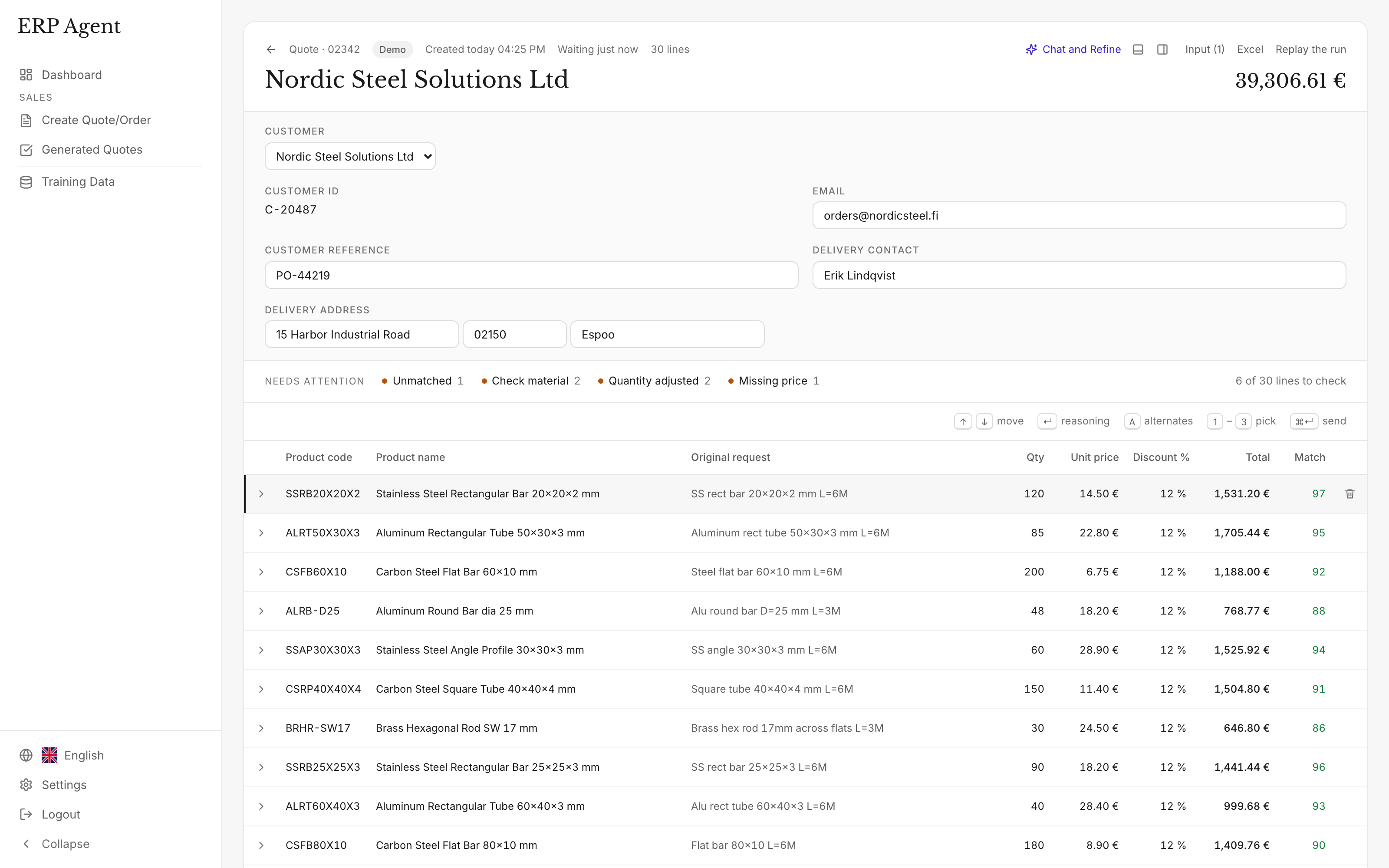
| Checking against the request | Every line carries a match score from 0 to 100; lines under 80 are marked, with the agent’s reasoning and alternative products a click away. |
| Keying into the ERP | Prepares the quote or sales order. Once your rep approves it, it lands in your ERP, CRM or other system. |
Costs the per-line formula leaves out
These come on top of the paid time. They depend on your customers and margins, so estimate them from your own records.
- Slow replies. A customer who asks several suppliers often orders from the first complete answer. Estimate it from lost-quote notes in your CRM: the losses that cite speed, times their average order value and margin. ERP Agent drafts a typical request in 3–8 minutes, so the reply is ready while the customer is still deciding.
- Errors and rework. A wrong size or price means a corrected quote, a credit note, a return or margin given away. Count these for a quarter, then multiply each case by its handling time at your loaded hourly cost and add the margin lost: that is what manual entry errors cost you. ERP Agent checks the attributes each line states and marks doubtful lines, so they are checked before a customer sees them.
- Selling time. Every hour spent keying lines is an hour your experienced reps are not calling customers or following up open quotes. With the finding and keying handed to the agent, that time goes back to customers.
- Knowledge that sits with a few people. Often only one rep knows which product a customer means by their own code. When that person is away or leaves, minutes per line rise and new reps take longer to get up to speed. ERP Agent learns from the lines your team sends, so that knowledge stays in the company.
What changes in the formula with ERP Agent
With ERP Agent, a rep forwards the customer’s request to your company’s agent mailbox or pastes it into the web app. The agent reads the email and attachments, identifies the right products in your own catalogue, brings in customer pricing and prepares a quote or sales order.
The rep’s minutes move from finding and keying to reviewing. Review starts where judgement is needed: the lines under 80, with the agent’s reasoning and alternative products a click away. Your team stays in control: a person reviews and approves the draft before anything lands in your ERP, CRM or other system, and every line your team sends teaches the agent for next time.
Agent run time is not rep time. A typical request takes the agent 3–8 minutes while the rep works on something else; fast mode handles requests of up to about 50 lines in 1–3 minutes. See AI quote automation for distributors.
ERP Agent works on top of your ERP, with no replacement project. It integrates with Business Central, SAP, NetSuite, Visma, IFS, Sage and any other ERP or CRM. We set up the connection for your company during onboarding, and you can start with a catalogue file the same week. See all integrations.
What 95% automation means for your minutes per line
Our customers average 95% automation, and at LVI-WaBeK, ERP Agent automates quote lines with over 95% accuracy. For the formula, that means your reps stop finding and keying every line and start from a prepared draft, with the doubtful lines already marked.
A pilot on your own requests turns this into your own review minutes per line, the one input your ROI calculation still needs. The AI quote agent pilot checklist has a scoring sheet for it.
How do you calculate quote automation ROI?
Start from your manual cost per month, then add what the tool costs and the review time it leaves. A pilot on your own requests gives you that review time.
Measure the review time
In a pilot, time the review: checking the marked lines, editing, and handling the customer’s requirements. That gives you review minutes per line.
Monthly saving
Quote lines per month × (manual minutes − review minutes) ÷ 60 × loaded hourly cost.
Net of the tool
Net monthly saving = monthly saving − monthly subscription.
Payback and first-year ROI
Payback in months = setup fee ÷ net monthly saving. First-year ROI = (12 × monthly saving − first-year cost) ÷ first-year cost, where first-year cost = setup fee + 12 × monthly subscription.
What one minute per line is worth
Each minute saved per line is worth quote lines per month × loaded hourly cost ÷ 60. In the quote-desk example (2,600 lines, €45 an hour) that is €1,950 a month, or €23,400 a year, for every minute. Try your own volumes in the quote cost calculator.
ERP Agent in numbers
- 4–7 min
- per line when quotes and orders are created by hand, according to our case study
- 95%
- average automation across our customers
- Over 95%
- accuracy in quote-line automation at LVI-WaBeK
- 3–8 min
- for the agent to prepare a typical request
Why CPQ or OCR does not remove the minutes per line
A CPQ configurator builds quotes from option rules for products made to order; it starts once someone already knows which products the customer means. OCR-only document parsing turns a PDF into text, and a rep still works out which catalogue product each line means and what this customer pays for it. Template-based capture needs a template for each customer’s document format before it can read that customer’s requests.
That is where a distributor’s minutes go, and it is the work ERP Agent does: it identifies the products from the customer’s own words, so there is nothing to map, and brings in the customer’s pricing. See CPQ vs AI quote automation.