On this page
CPQ vs AI quote automation at a glance
Each row is a question distributors ask when they compare the two approaches to quoting.
| CPQ (configure, price, quote) | ERP Agent (AI quote agent) | |
|---|---|---|
| Where the quote starts | A rep picks products and options in the CPQ screens | The customer’s email, PDF, Excel or Word request, exactly as it was sent |
| Who reads the customer’s request | The rep, before opening the configurator | The agent reads the email body and every attachment, including scanned PDFs and forwarded emails |
| Shorthand, customer codes, competitor part numbers | The rep translates them into catalogue items | Identifies the right products from abbreviations, dimensions, materials, part numbers and customer codes |
| Customer pricing | Price books and discount rules kept in the CPQ | From your ERP’s own customer prices and the rules configured for your company; no second price list to keep in sync |
| Set-up work | Modelling products, options and price rules, then keeping them current | Load your catalogue and past quotes; start with a catalogue file the same week |
| Checking the draft | Rules check option combinations, not what the customer asked for | A match score from 0 to 100 on every line; lines under 80 are marked, with reasoning and alternative products |
| Getting better over time | Product rules are updated by an administrator | Learns from the lines your team sends: the next time a customer writes the same thing, it picks the same product |
| Where the result goes | A quote document, usually in or synced with the CRM | A reviewed quote or sales order in your ERP, CRM or other system |
Definition
CPQ (configure, price, quote)Sales software that helps a seller configure a product from options, price it with rules and produce the quote document. It starts once the seller already knows what is being sold.
Definition
AI quote agentSoftware that reads an incoming request, such as an email with a PDF or spreadsheet, identifies which catalogue product each line means, brings in that customer’s prices and prepares a draft quote or sales order for a person to approve. It is also called AI quote automation or inbound RFQ automation.
CPQ for distributors: why most quotes are not a configuration problem
A distributor’s or wholesaler’s quote is usually a list. A contractor emails a few dozen lines of fixings, valves and fittings, some in their own shorthand (“M10 nyloc A2”), some as their own article codes, a few as a competitor’s part numbers. Nothing on the list needs configuring. Every line is a standard catalogue product; the work is deciding which one.
That decision is where the time goes. According to our case study, a sales rep spends on average 4–7 minutes per line when creating quotes and orders by hand. On a 40-line enquiry, that is several hours of reading each line, searching the catalogue, checking sizes and grades, finding the customer’s price and keying the line in. Put your own volumes into the quote cost calculator.
CPQ starts after that decision. A configurator is only useful once someone has read the customer’s list and worked out what it means, so the hours stay with your reps. And the parts CPQ automates, price rules and the quote document, are usually covered already by your ERP, which holds the customer prices and prints the quote. ERP Agent is built for the step CPQ leaves out: it reads the customer’s request and identifies the right product for every line.
Where the time goes in a distributor quote, step by step
The same enquiry handled three ways. A configurator joins once the rep knows what to sell; ERP Agent takes the request from the first line of the customer’s email.
| Step | By hand | With CPQ | With ERP Agent |
|---|---|---|---|
| Read the request | The rep reads the email and every attachment | As by hand | The agent reads the email body and attachments: PDF (including scanned), Excel, CSV, Word, images and forwarded emails |
| Decide which product each line means | The rep searches the catalogue by code or description | The rep searches the CPQ catalogue | The agent identifies the right product from shorthand, dimensions, part numbers and customer codes and scores every line from 0 to 100 |
| Check sizes, grades and ratings | From the rep’s experience | Rules check option combinations, not the customer’s wording | Candidates that contradict a stated size, voltage or rating class are pushed down the list |
| Price it for this customer | Looked up in the ERP | Price books and discount rules kept in the CPQ | Brought in from the data and rules configured for your company |
| Get it into the system | The rep keys every line | Synced, where the CPQ is integrated with the ERP | The approved quote or order lands in your ERP, CRM or other system |
| Approve | The rep, or a manager for large quotes | As by hand | A person reviews by default; lines under 80 are marked, so the rep starts with the lines that need them |
What a distributor needs from quote automation
ERP Agent is the first agentic AI layer for wholesale distribution ERP systems. These are the jobs it is built to do well, and the ones a configurator was never designed for.
- The right product from the customer’s own words. Abbreviations, dimensions, materials, technical descriptions, part numbers and customer codes are matched to your catalogue, and the original request stays next to each proposed match. Competitor part numbers map to your own equivalents through cross-reference data set up for your company.
- Customer pricing without a second price list. Prices come from the data and rules configured for your company, so nothing has to be kept in sync with the ERP. Your team can review and edit any price before sending.
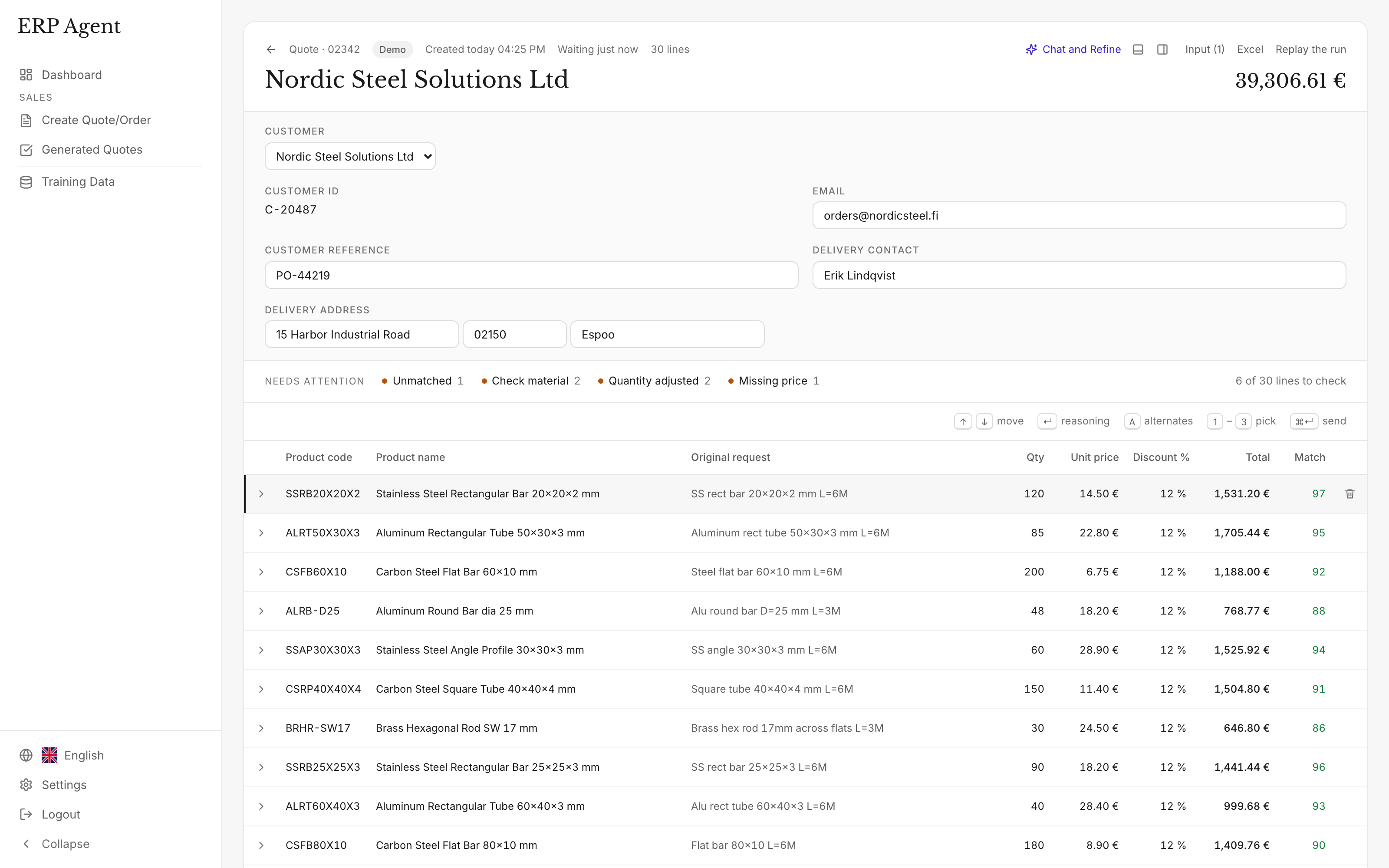
- A draft you can check at a glance. Every line carries a match score from 0 to 100; lines under 80 are marked for review. Open any line to read why the agent chose that product, or take one of the alternatives it found.
- Edits in plain language. In quote chat your rep adds or removes rows and changes quantities, prices or other details. Every proposed edit is approved or rejected line by line.
- Requests in your customers’ languages. A request in one language is matched against a catalogue in another, without anyone translating it first.
- Quotes and sales orders. The rep chooses a quote or a sales order when the request comes in; the same product identification applies to both. See order entry automation.
- Learning from your team, not from rule-writing. The agent learns from the lines your team sends, so the knowledge of which product a customer means stays in the company and new reps quote sooner.
When does a distributor need an AI quote agent?
If two or more of these sound like your sales desk, the quote bottleneck is reading the request, and that is the work ERP Agent takes off your reps:
- Requests arrive by email as PDFs, spreadsheets, Word lists or a few lines in the email body. See RFQ automation for distributors.
- Lines name standard catalogue products in the customer’s shorthand, their own article codes or a competitor’s part numbers. See customer part number cross-reference.
- Requests run to tens or hundreds of lines, so minutes per line add up to hours per quote and slower replies to customers.
- Customer-specific prices already live in your ERP and should come from there.
- Knowing which product a customer means sits in a few experienced heads, and you want new reps quoting sooner.
Example: a customer’s list, drafted from your catalogue
An industrial customer emails a 25-line list; five lines are shown. Prices are left out; in a real draft they come from the customer’s terms.
“Can you quote the attached for delivery to our Leeds site? Same terms as last time.”
- 50 x hex bolt M12 x 60 8.8 zinc
- 10 x ball valve 1" BSP brass F/F
- 20 m 2SN hose 1/2"
- 4 x our code HX-220
- 2 x pressure gauge 0-16 bar 63mm
| Request line | Proposed product | Qty | Match | Note |
|---|---|---|---|---|
| hex bolt M12 x 60 8.8 zinc | Hex bolt ISO 4014 M12 × 60, 8.8, zinc plated | 50 | 86 | Partly threaded bolt proposed; the fully threaded set screw is offered as the alternative. |
| ball valve 1" BSP brass F/F | Ball valve DN25, 1" BSP female/female, brass | 10 | 91 | Size, thread and material match the request. |
| 2SN hose 1/2" | Hydraulic hose EN 853 2SN, DN12 (1/2"), per metre | 20 m | 88 | “2SN” read as the EN 853 hose type. |
| our code HX-220 | Hose clamp W2 20-32 mm, stainless | 4 | 97 | The customer’s own code, learned from an earlier quote. |
| pressure gauge 0-16 bar 63mm | Pressure gauge Ø63, 0–16 bar, bottom connection 1/4" BSP | 2 | 77 | Connection position not stated; the back-entry version is offered as the alternative. Marked for review. |
Sample data, showing how each line of a draft is presented for review.
Already running a CPQ? Keep it, and take the requests off your reps
ERP Agent does not ask you to rip anything out. If you already use a CPQ for configured or built-to-order products, it keeps doing that job. ERP Agent works on top of your ERP and takes on the step a configurator never covered: reading the customer’s request, identifying the right products and preparing the draft with customer pricing.
There is no second product model to build and no rules to write. Your ERP stays the record for products, customers and prices; ERP Agent reads from it and puts the reviewed quote or sales order into your ERP, CRM or other system. Customer purchase orders get the same treatment on their way to becoming sales orders; see purchase order to sales order.
What is replacing CPQ?
For a wholesale distributor, what is replacing CPQ is not a smarter configurator. It is an AI agent that starts where the quote starts: the customer’s own email and files. Adding an AI assistant to a CPQ still leaves the rep typing the prompt on top of the same product rules, so someone still reads every line of the request first.
ERP Agent takes that reading off your reps. It reads the customer’s email and attachments, identifies the right products in your catalogue, brings in customer pricing and hands your rep a draft to approve. That is what is replacing manual quoting in distribution. See how ERP Agent automates quotes.
What is AI CPQ, and how is it different from an AI quote agent?
AI CPQ is configure, price and quote software with an AI assistant for the seller. It sounds like AI quote automation, but it starts from a different input and saves a different kind of work.
| Question | AI CPQ | ERP Agent (AI quote agent) |
|---|---|---|
| Input | A rep’s prompt or chat, describing what the customer needs | The customer’s email and attachments, as sent |
| Who reads the customer’s request | The rep, before writing the prompt | The agent |
| What the AI works from | The CPQ’s product model, rules and price books | Your catalogue, customer codes, past quotes and customer pricing |
| What it saves | Clicks and lookups while configuring and pricing | Reading, identifying and keying every line of the enquiry |
| What you maintain | Product rules, kept up to date | No product rules to write: the agent learns from the lines your team sends |
How to work out what an AI quote agent would save you
Answer these with last month’s quotes.
Where did each quote start?
Sort them: the customer’s email or file, a phone call, or a rep building a configuration. Every quote that started as a customer’s document is work ERP Agent can take on.
What share of lines are standard catalogue items?
If nearly every line is a product you already carry, configuration is not your bottleneck. Finding the right product is.
How many lines does a typical request have?
Lines × minutes per line is the manual cost. The quote cost calculator does the arithmetic with your own figures, and the cost of manual quoting explains each input.
Where do customer prices live?
If the answer is the ERP, the prices should come from there rather than from a second price list. ERP Agent brings in customer pricing from the data and rules configured for your company.
Where must the quote land?
Name the system: ERP, CRM or other. ERP Agent integrates with Business Central, SAP, NetSuite, Visma, IFS, Sage and any other ERP or CRM, and we set up the connection for your company during onboarding. See all integrations.
Test on your own requests
Bring real enquiries, including the awkward ones, and score right product, right price, lines edited and time per line. The AI quote agent pilot checklist has a scoring sheet, and the cost of manual quoting shows what the time saved per line is worth.
How ERP Agent handles distributor quotes
ERP Agent reads customer requests from email, PDF, Excel and Word, identifies the right products in your own catalogue, brings in customer pricing and prepares a quote or sales order your team reviews before it lands in your ERP, CRM or other system. Each company gets its own agent mailbox: reps forward requests there or paste them into the web app, and a typical request is ready for review in 3–8 minutes.
Every line carries a match score from 0 to 100, and lines under 80 are marked for review. The rep can read the agent’s reasoning, take an alternative product or edit the draft in quote chat, approving each change line by line. The lines your team sends teach the agent: the next time a customer writes the same thing, it picks the same product.
ERP Agent integrates with Business Central, SAP, NetSuite, Visma, IFS, Sage and any other ERP or CRM. We set up the connection for your company during onboarding, and you can start with a catalogue file the same week.
ERP Agent in numbers
- 4–7 min
- per line when quotes and orders are created by hand, according to our case study
- 95%
- average automation across our customers
- Over 95%
- accuracy in quote-line automation at LVI-WaBeK
- 3–8 min
- for the agent to prepare a typical request
Built to fit how your team already works
- Works on top of your ERP. No replacement project: your ERP stays the system of record, and ERP Agent prepares the work that goes into it.
- Your team stays in control. A person reviews by default before anything is written to your ERP, CRM or other system, and nothing reaches a customer without approval.
- Start with a catalogue file. Connect your ERP when you are ready; the agent is useful from the first request.
- GDPR-compliant. Models run with zero data retention, and before setup we agree which data the agent needs and which systems it can access. See security and data.
- Open to your own tools. Your systems and AI agents can send requests through the public REST API or the remote MCP server.
ERP Agent is live with steel, HVAC and fastener distributors. Read how LVI-WaBeK turns customer requests into quote lines with the right products and prices.