On this page
What is quote turnaround time?
Quote turnaround time is the elapsed time between a quote request arriving and the quote being sent to the customer, also called time to quote or quote response time. At a wholesaler the request is usually an enquiry by email with a PDF, spreadsheet or Word list attached (see the difference between an RFQ, an RFP and a quotation), and the quote is created in the ERP, CRM or other system and emailed back.
Two measures get mixed up, and the difference decides what you fix. Elapsed time is the clock time the customer experiences, including evenings, weekends and the hours the request sat unopened. Touch time is the time someone actually works on it. At 4–7 minutes per line, a 30-line enquiry is two to three and a half hours of touch time, and it can still take three days to go out because nobody had those hours free in one block.
Agree the start and stop points first. Start the clock when the request reaches any inbox at your company, not when a rep opens it. Stop it when the quote leaves for the customer, not when it is saved in the ERP: a quote waiting for a manager’s sign-off is not finished from where the customer sits.
The distributor quoting process, stage by stage
Whatever the trade, most distributor quotes pass through the same seven stages.
| Stage | What happens | What makes it slow | Grows with |
|---|---|---|---|
| 1. Intake | The request lands in a personal, shared or branch inbox and someone takes ownership. | No clear owner; the request waits for a rep who is out on site. | Inboxes, holidays, workload |
| 2. Reading | The rep works out what is asked: products, quantities, delivery, special terms. | Scanned PDFs, long email chains, one list split across attachments. | Request format |
| 3. Identifying products | Each line is matched to a catalogue product: shorthand, dimensions, grades, customer and competitor codes. | Missing sizes or grades, codes only one colleague knows, near-identical variants. | Number of lines |
| 4. Pricing | Customer prices, discounts and project prices are applied; items you do not normally carry need a supplier price. | Price agreements kept outside the ERP; waiting for a supplier. | Lines and special prices |
| 5. Entering | Lines are keyed into a quote in the ERP, CRM or other system. | Re-typing what was already worked out. | Number of lines |
| 6. Approval | Large or low-margin quotes go to a manager. | Approvals cleared once a day; the whole quote waiting for one line. | Quote value, approval rules |
| 7. Sending | The quote goes out; questions about unclear lines go back to the customer. | Holding the whole quote until every question is answered. | Unclear lines |
Stages 3 to 5 are per-line work, which is why line count drives touch time. ERP Agent takes over the reading, product identification, customer pricing and entry. Stages 1, 6 and 7 are mostly waiting, which is why elapsed time can be many times the touch time.
What drives quote turnaround time in distribution?
Six factors explain most of the gap between a quote that goes out the same morning and one that goes out next week.
- Line count. Twice the lines means roughly twice the touch time. Long requests also wait longest, because they need an uninterrupted block of a rep’s day that rarely appears between calls and counter customers.
- How the customer writes. Requests come in the customer’s shorthand, their own article codes, a competitor’s part numbers or a description copied from a drawing. “SS rect tube 40x20x2 6M” has to become one specific product in your catalogue; the less a request looks like your catalogue, the longer each line takes.
- Product matching. In catalogues full of close variants (thread sizes, stainless grades, pressure classes, fire ratings), the slow part is ruling out the wrong candidates. A line that does not state the grade becomes a question for the customer.
- Customer pricing. When net prices and discount agreements live in the ERP, pricing is a lookup. When they live in a spreadsheet or a colleague’s head, every line becomes a search.
- Approvals and handovers. Margin sign-offs, a second rep for a specialist area and a manager who approves once a day add elapsed time without adding work.
- Who knows what. If only one rep knows what a customer’s “VA-220” means, that customer’s quotes wait for that rep. New reps are slowest, because they are still learning the catalogue and the customers.
Where the hours go: a worked example
Swap in your own request sizes. The per-line time comes from our case study: a sales rep spends on average 4–7 minutes per line when creating quotes and orders by hand.
| Request size (example) | Touch time at 4–7 minutes per line | What it means for the sales desk |
|---|---|---|
| 5 lines | 20–35 minutes | Fits between other work, so it can go out the same day. |
| 25 lines | 100–175 minutes (1 h 40 min to almost 3 h) | Needs a planned block and slips easily to the next day. |
| 60 lines | 240–420 minutes (4–7 hours) | Most of one rep’s day, usually split across two or three days. |
| 300 lines | 1,200–2,100 minutes (20–35 hours) | Several working days, often shared between reps. |
Touch time only: waiting, approvals and questions to the customer come on top. For monthly effort, multiply lines per month by 4–7 minutes; the quote cost calculator does it with your own volumes and hourly cost, and the guide to the cost of manual quoting explains what to include.
This is why small requests tend to go out quickly while large ones wait. A five-line enquiry fits into a gap; a sixty-line project list needs most of a day nobody has. The requests worth the most, and the ones a buyer is most likely to send to several suppliers at once, queue longest.
ERP Agent turns that around. A typical request is prepared in 3–8 minutes, and a request of several hundred lines, the kind that takes a rep several working days by hand, in about half an hour. Fast mode handles requests of up to about 50 lines in 1–3 minutes. The long, valuable requests stop being the slow ones, and the rep’s time goes to checking the lines that need judgement.
How to measure quote turnaround time
A shared spreadsheet and a few weeks of honest logging give you a baseline to measure every improvement against.
Fix the start and stop points
Start: when the request reached your company’s inbox. Stop: the time in sent items when the quote went out. Write the definition down so every branch logs the same thing.
Log every request for a few weeks
Include the quick ones and the ones that never got a reply. Use the columns in the log below.
Separate elapsed time from touch time
Ask reps to note roughly how long they worked on each quote. Elapsed minus touch time is waiting; touch time is the per-line work.
Report by size band, not one average
Group requests by line count, for example 1–10, 11–50 and over 50 lines. One 300-line project list can swamp the average of a hundred small requests.
Use the median and the slow tail
The median shows a normal day; the slowest tenth of requests shows where customers wait longest. Track both monthly, per band.
Connect speed to orders
Mark which quotes became orders. Comparing fast and slow quotes within the same size band shows what turnaround is worth in your business.
A turnaround log you can copy
One row per request. The example row shows the format.
| Request | Received | First opened | Sent | Lines | Lines queried | Touch time | Handled by | Became an order |
|---|---|---|---|---|---|---|---|---|
| Example: contractor enquiry, PDF | Mon 08:12 | Mon 13:40 | Tue 10:05 | 42 | 3 | 3 h 30 min | Rep B | Yes |
From these columns you get elapsed time (Sent minus Received), waiting before work started (First opened minus Received), touch time per line, the share of lines that needed a question, the requests that never got a quote, and the order rate of fast versus slow quotes.
Your own baseline is the number to beat
A five-line request and a three-hundred-line project list cannot share one target, and an outside average says nothing about your catalogue, your customers or where your clock starts. Set a target per size band from your own median and track it monthly. The same baseline shows what ERP Agent is worth to you: run your own requests through it in a pilot and compare band by band.
How to reduce quote turnaround time
Process changes remove the waiting; an AI quote agent removes the per-line work. Do both, and the long requests stop being the slow ones.
Give every request one route and one owner
Send enquiries to one shared address and decide who owns each request as soon as it arrives, including when the usual rep is away. With ERP Agent, your company gets its own agent mailbox: forward a request there and the draft is prepared automatically while the rep is on a call or out on site.
Triage by size
Answer small requests first. For long lists, reply straight away with the date the quote will follow, so the customer knows it is coming.
Quote the clear lines, ask about the rest
Do not hold a 40-line quote for two unclear lines. Send what you can price, mark the open lines and ask the specific question (“A2 or A4 stainless?”) in the same email.
Keep pricing and approvals in the system
Move customer price agreements and project prices into the ERP, send only real exceptions to a manager, and agree fixed times during the day when approvals are cleared.
Keep customer-code knowledge in the company
Record which of your products each customer code and competitor part number stands for, so the knowledge does not sit with one rep. ERP Agent builds this as it works: it learns from the lines your team sends, and the next time a customer writes the same thing, it picks the same product. More on customer part numbers and part number cross-reference.
Remove the per-line work
Line count is the biggest lever on the long requests. Reading the request, identifying the right products, bringing in customer pricing and preparing the draft is the work an AI quote agent takes over, leaving the rep to review.
Ways to cut per-line work, compared
Code lists, portals, EDI, CPQ and OCR each handle one slice of the work. On a free-form request with many lines, ERP Agent takes over the per-line work itself.
| Approach | What it handles | What the rep still does on a free-form request |
|---|---|---|
| Customer code lists in the ERP | Repeat lines from known customers who use known codes | Every line with new wording, from a new customer or with a competitor’s code |
| Webshop or customer portal | Orders from customers who search your catalogue themselves | Every enquiry that still arrives by email, PDF or spreadsheet |
| EDI | Structured orders from trading partners using agreed codes | Every request from everyone else |
| CPQ configurator | Quotes built from option rules for configured products | Finding each catalogue product in the customer’s list |
| OCR or document parsing | Turning a PDF or scan into text | Deciding which product the text means, pricing it and keying it in |
| ERP Agent | Reading the request and attachments, identifying the right product for every line, customer pricing and preparing the quote or sales order | Checking the lines marked for review and approving |
Code lists, portals and EDI keep serving the customers who use them; ERP Agent handles the requests that arrive the way customers actually write. More in CPQ vs AI quote automation and on how ERP Agent automates quotes.
What changes when ERP Agent does the per-line work
A rep forwards the customer’s email to the company’s own agent mailbox or pastes it into the web app unedited. ERP Agent reads the email and attachments (PDF, including scanned PDFs, Excel, CSV and Word), identifies the right product in your catalogue for each line from abbreviations, dimensions, materials, part numbers and customer codes, brings in customer pricing from the data and rules configured for your company, and prepares a quote or sales order. A request written in one language is matched against a catalogue in another.
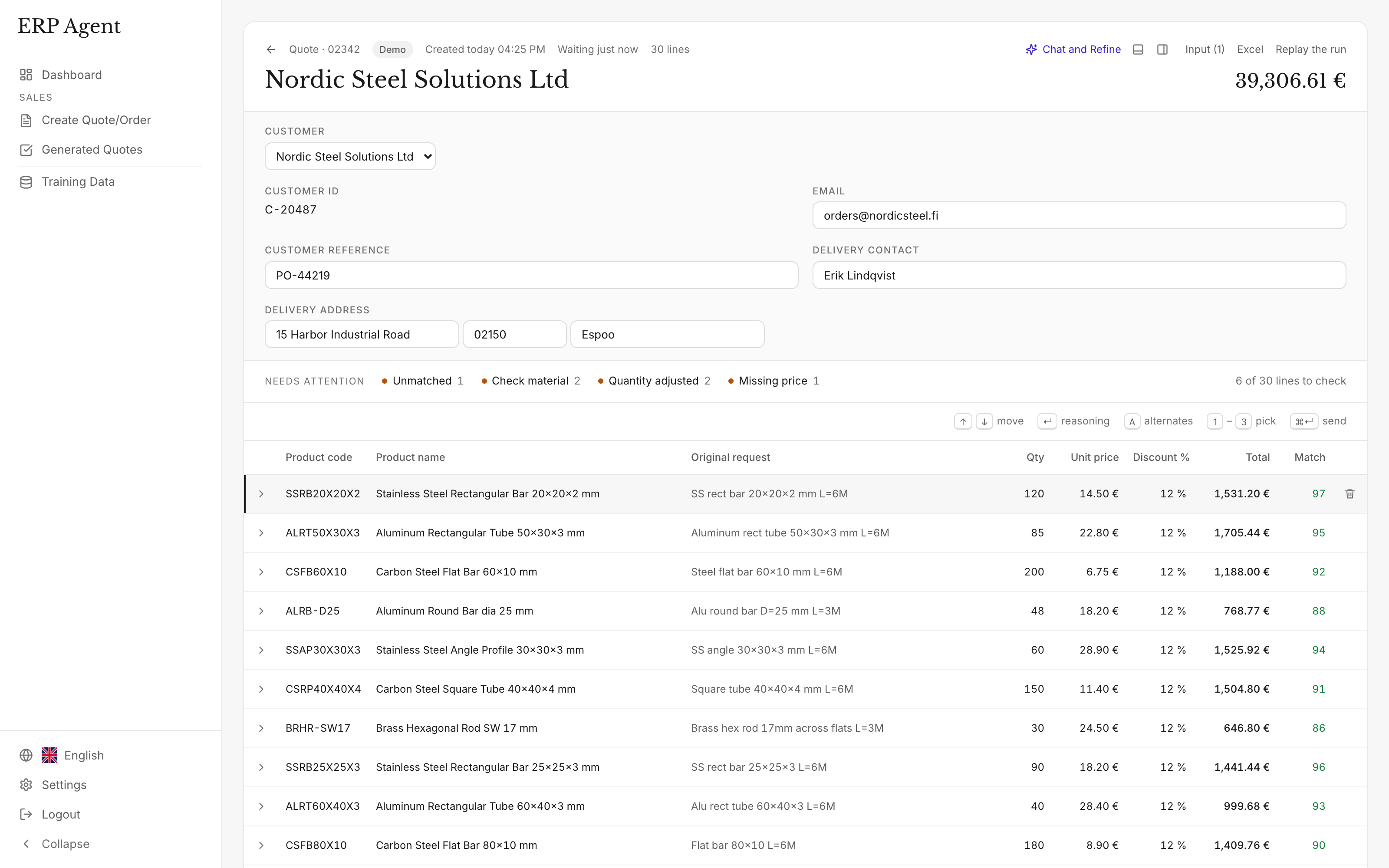
The rep’s work moves from keying every line to checking the lines that need judgement. Every line carries a match score from 0 to 100, and lines under 80 are marked for review. Open a line to read the agent’s reasoning or take an alternative product; ask for changes in quote chat and approve or reject each one. Your team stays in control: a person reviews by default before anything is written to the ERP, CRM or other system.
The agent learns from the lines your team sends: the next time a customer writes the same thing, it picks the same product. Customer-code knowledge stays in the company, new reps are productive sooner, and customers get an answer quickly even when the request is long.
ERP Agent works on top of your ERP, with no replacement project. It integrates with Business Central, SAP, NetSuite, Visma, IFS, Sage and any other ERP or CRM. We set up the connection for your company during onboarding, and you can start with a catalogue file the same week. See how each connection works.
ERP Agent in numbers
- 4–7 min
- per line when quotes and orders are created by hand, according to our case study
- 3–8 min
- for ERP Agent to prepare a typical request
- 1–3 min
- in fast mode, for requests of up to about 50 lines
- 95%
- average automation across our customers
- Over 95%
- accuracy in quote-line automation at LVI-WaBeK
What to ask before you choose a tool to speed up quotes
Have your baseline per size band ready, so you can measure the difference. Then put these questions to every option you consider.
| Question | Why it matters | ERP Agent |
|---|---|---|
| Does it work from your catalogue and customer prices? | A tool that only extracts text leaves the product search and pricing to the rep. | Identifies the right product in your own catalogue for every line and brings in customer pricing from the data and rules configured for your company. |
| Does it handle your hardest requests? | Scanned PDFs, shorthand, customer codes and lines without a grade are where the time goes. | Reads PDF (including scanned), Excel, CSV and Word, and maps abbreviations, dimensions, part numbers and customer codes to your products, across languages. |
| What does the rep see on an uncertain line? | Review is fast only when the uncertain lines stand out. | A match score from 0 to 100 on every line; lines under 80 are marked, with the reasoning and alternative products one click away. |
| Where does the result land? | A file someone re-keys brings the per-line work back. | A quote or sales order in your ERP, CRM or other system. |
| Who approves before anything goes out? | Your customers see the quote, not the tool. | Your team. A person reviews by default, and the agent cannot send anything to a customer on its own. |
| Does it learn from your team? | Customer-specific wording should only need teaching once. | Yes: the next time a customer writes the same thing, it picks the same product your team sent. |
| Does it work with your ERP? | A tool tied to a short list of systems limits where you can use it. | Yes: Business Central, SAP, NetSuite, Visma or any other ERP or CRM, with the connection set up for your company during onboarding. Start with a catalogue file the same week. |
| Can you test it on your own requests? | A tidy demo list proves little. | Yes. Bring your real requests; the AI quote agent pilot checklist shows how to run a fair test. |