Integration · Monitor ERP
AI quote and order automation for Monitor ERP
ERP Agent reads the customer’s request from email, PDF or Excel, identifies the right parts in your Monitor part register, brings in that customer’s price from Monitor’s own price calculation and creates a quote or customer order in Monitor once your rep has approved it. We set up the Monitor ERP connection for your company during onboarding.
What ERP Agent reads from Monitor ERP
The connection runs through the Monitor ERP API, Monitor’s REST API. ERP Agent reads with the API’s queries, which give fast read access to the data in Monitor, and works from your part register as it is today.
| Data in Monitor ERP | Through the Monitor ERP API | What ERP Agent does with it |
|---|---|---|
| Parts | Queries on the part register | Identifies the right part for every request line from the customer’s own wording, and checks each part number exists before anything is written |
| Customers | Queries on the customer register | Finds the customer behind the request, warns the rep when none matches and flags a delivery address that differs from the one in Monitor |
| Customer prices | The GetPriceInfo command, which calculates the sales price for a given part, customer and unit | Brings in the price Monitor calculates for that customer, so the rep reviews the draft with real prices |
Your part register, price lists and customer records stay exactly as they are: the agent reads them and never changes them.
What ERP Agent writes to Monitor ERP
Two documents, both written with the API’s commands only after a rep has approved the draft.
| Document | Monitor ERP API command | What is written |
|---|---|---|
| Quote | Sales/Quotes/Create, with quote rows | The customer, the quote type you chose and every approved line with part, quantity and price, from Monitor or as your rep set it in review |
| Customer order | Sales/CustomerOrders/Create, with order rows | The customer, the order type you chose and the same approved lines, ready for your normal order flow |
Both are ordinary Monitor documents your team opens and edits like any other. When the customer accepts, the quote becomes a customer order the usual way in Monitor.
Why Monitor companies add an AI quote agent
Many companies on Monitor sell more than what they build to order: standard parts, spare parts and traded goods that customers request by email, in their own words and with their own part numbers. The hard part is rarely entering the quote in Monitor. It is reading “carrier roller Ø50 L=600” and knowing which part that is, what this customer pays for it and which lines need a second look. According to our case study, a sales rep spends on average 4–7 minutes per line when creating quotes and orders by hand; for a 30-line enquiry, that is two to three and a half hours.
ERP Agent does that groundwork. It is the first agentic AI layer for wholesale distribution ERP systems, and on Monitor it works on top of the system you already run: no replacement project, and quotes and orders stay ordinary Monitor documents. Customers get answers sooner, reps spend their time on judgement and selling, and new reps are productive sooner. Put a number on today’s manual work with the quote cost calculator.
The same agent runs quote automation and order entry automation on any ERP; this page covers what it does inside Monitor ERP.
How Monitor ERP quote automation works
A request reaches the agent
Reps forward the customer’s email from Outlook to your company’s own agent mailbox, or paste it into the web app as it is and choose quote or customer order. PDF (scanned too), Excel, CSV, Word, images and forwarded emails all work. Your own systems can send requests through the REST API or the MCP server.
It finds the customer and the parts
The customer is identified from the request and matched in Monitor. Abbreviations, dimensions, materials, part numbers and customer codes are mapped to your parts, and candidates that contradict a stated size, voltage or pressure class are pushed down. An English request finds parts with Swedish descriptions. A line too vague to identify goes on your placeholder part with the customer’s wording kept, never a guess.
Prices come from Monitor
Each line carries the sales price Monitor’s price calculation gives that customer for the part and unit. Standard fee rows, such as freight or packing, are added following your rules.
A rep reviews the draft
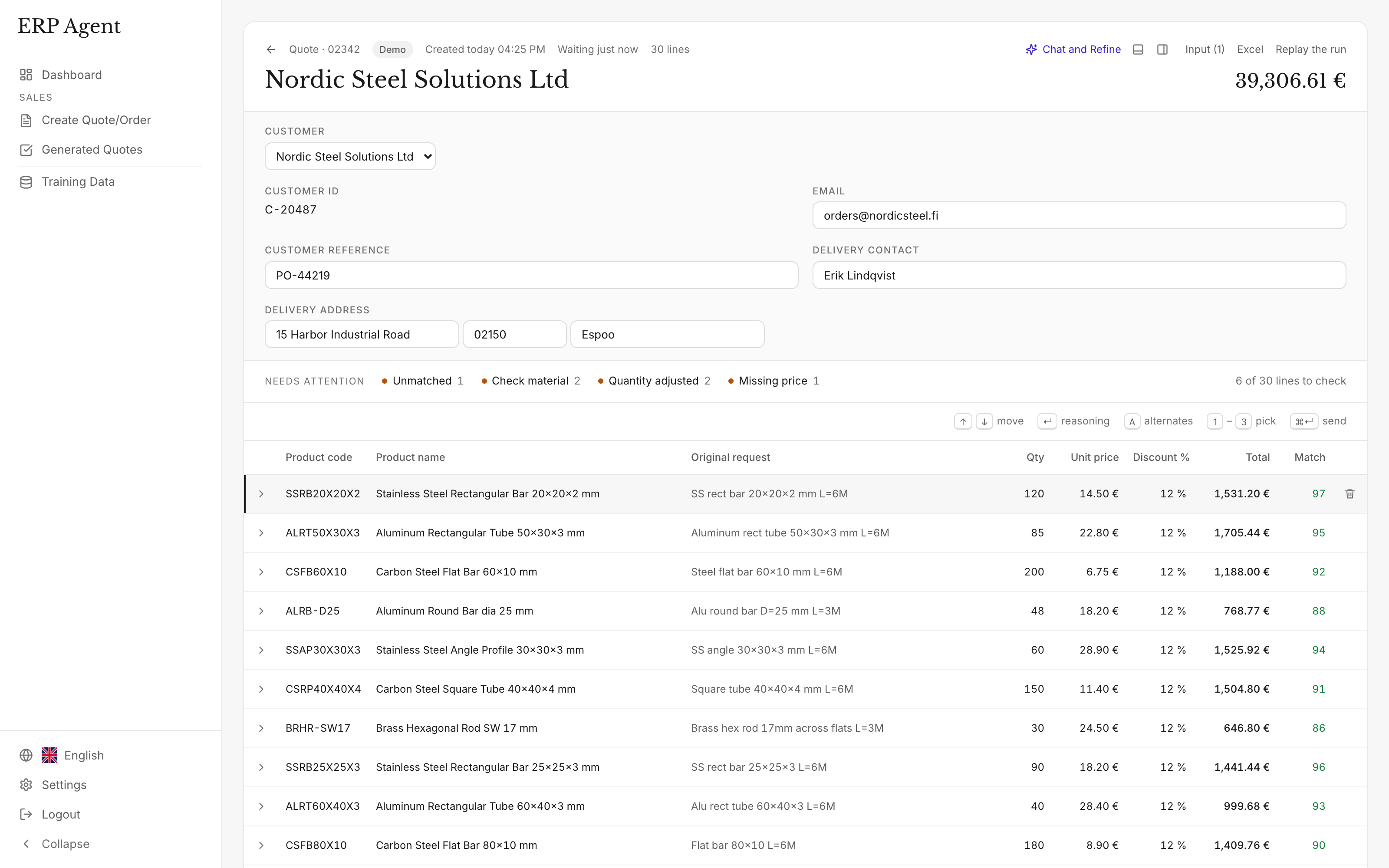
Lines appear in the table as they are matched. The rep checks the marked ones, takes an alternative where needed, makes changes in quote chat and approves.
It is created in Monitor
Every part number is checked against Monitor first, so a document never carries a number Monitor doesn’t know. A short countdown lets the rep cancel. The lines your team sends teach the agent: the next time a customer writes the same thing, it picks the same part.
Example: a spare parts enquiry becomes a quote in Monitor
The maintenance team at a food plant emails an enquiry to a conveyor manufacturer that runs Monitor ERP and sells spare parts to its customers. The agent mailbox is set to create quotes.
“Hi, could you quote the below for line 3? Delivery to the Kristianstad plant.”
- Carrier roller Ø50 L=600 – 20 pcs
- PVC belt 2 mm w=500 – 12 m
- Drive drum Ø100 for TB-500 – 1 pc
- Geared motor 0.75 kW 230/400V – 1 pc
- Our ref. LF-0193 – 6 pcs
- Misc. screws for the assembly – 1 pc
| Request line | Proposed Monitor part | Qty | Match | Note |
|---|---|---|---|---|
| Carrier roller Ø50 L=600 | Carrier roller Ø50 × 600 mm, galvanised, spring-loaded shaft | 20 | 91 | Diameter and length match; stainless version kept as an alternative. |
| PVC belt 2 mm w=500 | Conveyor belt PVC 2 mm, width 500 mm, sold per metre | 12 m | 88 | Thickness and width match. |
| Drive drum Ø100 for TB-500 | Drive drum Ø100 mm for conveyor TB-500 | 1 | 93 | The model name TB-500 is in the part description. |
| Geared motor 0.75 kW 230/400V | Geared motor 0.75 kW, 230/400 V, 50 Hz | 1 | 76 | Ratio not stated: the version this customer bought before is proposed, another ratio kept as an alternative. Marked for review (under 80). |
| Our ref. LF-0193 | Belt scraper PU, width 500 mm | 6 | 98 | The customer’s own code, learned from an earlier order. |
| Misc. screws for the assembly | Placeholder part, wording kept | 1 | – | Too vague to identify; the rep decides. |
Illustrative example with sample parts, codes and scores. In a real draft each line also carries the customer’s price from Monitor, and the Kristianstad delivery address is flagged if it differs from the customer’s address in Monitor.
What the rep sees before anything reaches Monitor
- A match score from 0 to 100. Lines under 80 are marked, so review starts where judgement is needed. How the match score works.
- Reasoning. Open a line to see why the agent chose that part.
- Alternatives. Runner-up parts are kept for every line; take one instead with a click.
- Quote chat. Add or remove rows or change quantities and prices, then approve or reject each proposed edit line by line.
- Your team stays in control. The rep approves the draft before it is created in Monitor, and nothing reaches a customer without approval.
Security and control
- GDPR-compliant, zero data retention. ERP Agent is GDPR-compliant, and models run with zero data retention. More on security and data handling.
- Access agreed first. Before setup, we agree which data the agent needs and which systems it can access.
- Its own API user. The agent signs in as a dedicated API user in Monitor, as Monitor recommends. Everything it does runs with that user’s permissions and shows in Monitor’s change log.
- A person approves. Nothing is written to Monitor until a rep approves the draft, and nothing reaches a customer without your team.
- Reads, never rewrites. Parts, prices and customer records are read; the agent creates quotes and customer orders and changes nothing else.
Onboarding: what we need from you
We set up the Monitor ERP connection for your company during onboarding. Your reps don’t wait for it: they start with a catalogue file the same week.
A catalogue export
An export of your part register from Monitor, for example to Excel or CSV. Reps forward real requests from the first week, reviewing every draft in the web app. See starting from a catalogue file.
An API user for ERP Agent
An API user in Monitor for ERP Agent, with permission to read parts, customers and prices and to create quotes and customer orders. We go through the API access with you during onboarding.
Your company and document types
The address of your Monitor API, which Monitor company the agent works in, and which quote and order types it should use.
Your rules and history
Which placeholder part takes lines too vague to identify, which fee rows the agent adds, and past quotes or Outlook email history, so the agent learns how your customers write.
Live in Monitor
Once the connection is live, customer prices come from Monitor and approved quotes and customer orders are created there directly.
ERP Agent in numbers
- 4–7 min
- per line to create quotes and orders by hand, according to our case study
- 95%
- average automation across our customers
- 3–8 min
- for the agent to prepare a typical request
- 1–3 min
- in fast mode, for requests of up to about 50 lines
Monitor today, any ERP tomorrow
ERP Agent integrates with Monitor, Business Central, SAP, Visma, IFS and any other ERP or CRM. We set up the connection for your company during onboarding, and you can start with a catalogue file the same week. Group companies on different systems use the same agent and the same review screen on each. See Visma, IFS and all integrations.
ERP Agent is live with steel, HVAC and fastener distributors. What it checks on each line follows your trade: dimensions and designs for industrial distributors, grades and lengths for steel stockholders, DIN and ISO codes for fastener distributors.
Frequently asked questions
Does ERP Agent work with Monitor ERP?
Yes. ERP Agent reads parts, customers and prices from Monitor ERP through the Monitor ERP API and creates quotes and customer orders there after a rep approves. We set up the connection for your company during onboarding, and you can start with a catalogue file the same week.
Does it create quotes or customer orders in Monitor?
Both. In the web app the rep chooses quote or customer order for each request; emails forwarded to the agent mailbox become the document type your company has chosen. For customer purchase orders arriving by email, see purchase order to sales order automation.
Does ERP Agent replace MAiA?
No. MAiA is Monitor’s AI assistant that answers questions about orders, customers and deliveries in the Monitor web client. ERP Agent does the quoting itself: it turns the customer’s request into a quote or customer order in Monitor, identifies the right parts from customers’ shorthand in requests of several hundred lines, scores every line from 0 to 100 with its reasoning and alternatives, matches across languages and learns from the lines your team sends.
What does ERP Agent need access to in Monitor?
A dedicated API user with permission to read parts, customers and prices and to create quotes and customer orders. We agree the scope with you before setup.
Which Monitor versions does it work with?
Monitor ERP (Monitor G5) versions that offer the Monitor ERP API. The commands for creating quotes and customer orders are documented from version 2.18. On an older version, we go through the options during onboarding.
Where do the prices on a Monitor quote come from?
From Monitor: each line carries the sales price Monitor’s price calculation gives that customer for the part and unit. The rep can review and edit any price before sending.
How do we get started?
Book a call and bring a few real requests. You start with a catalogue file the same week, and we set up the Monitor connection during onboarding. Pricing is a setup fee plus a monthly subscription, with an itemised quote before you start. See pricing.
Related
- AI quote automation for distributors and wholesalers
- Order entry automation for distributors: customer POs to sales orders
- ERP integrations for AI quote and order automation, on any ERP system
- Industrial supplies distributor quote automation: from MRO enquiry to reviewed quote
- Fastener quoting software: from customer shorthand to a reviewed quote
- AI quote and order automation for Visma
Let’s look at your quote workflow
Bring a request from your inbox
Book a 30-minute call with a few real requests; we’ll show how the agent handles them with your parts and what connecting your Monitor ERP involves.
- Your requests and product catalogue
- Your pricing and review process
- A clear scope for the next step

Lauri Pelkonen
Founder & CEO
Book a 30-minute call Request a demo by emailOr use the address directly