Part-number cross-reference
Customer part number cross-reference: match every code on an enquiry to the right product in your catalogue
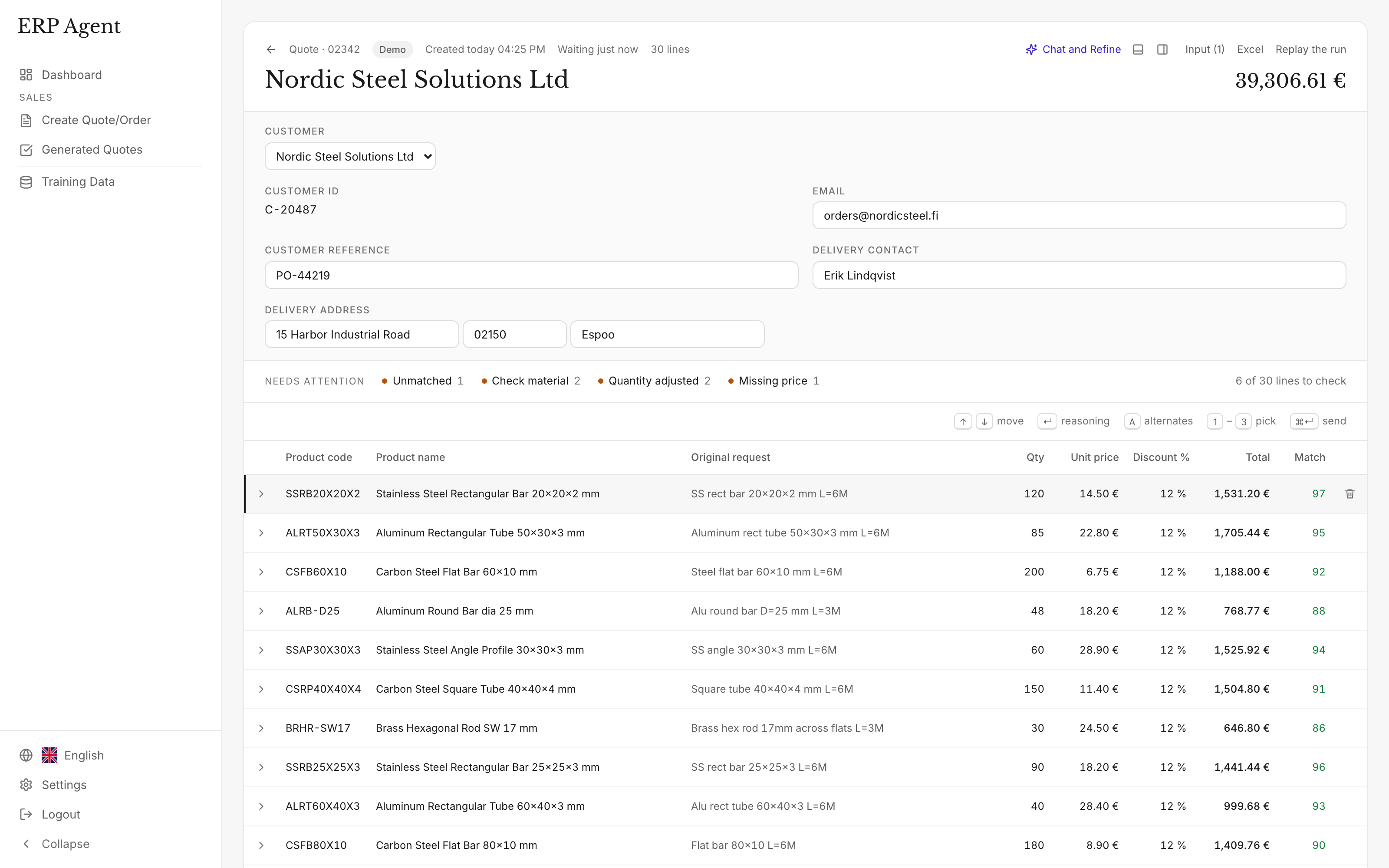
ERP Agent cross-references every code on a customer enquiry to the right product in your own catalogue: the customer’s own part numbers, competitor and manufacturer codes, drawing numbers and shorthand. It handles every line of the request in one run, shows the original next to each proposed product with a 0–100 match score, and learns each pair your team confirms.
Why do customer part numbers slow down quoting?
Customers rarely write your product codes. A maintenance buyer copies the part number from their own purchasing system. A contractor quotes the code of the brand they bought last time. A project list gives a manufacturer’s number, a drawing reference or shorthand like “HDG M12x60 8.8 DIN 933”. Before anything can be priced, someone on your sales desk has to translate each line into your own SKU.
That translation lives in spreadsheets, a half-filled customer part number field in the ERP, supplier interchange lists and, mostly, experienced reps’ memory. Every line needs its own lookup. When the rep who knows a key account’s codes is away, the enquiry waits. When that rep leaves, the knowledge leaves too.
Why distributors choose ERP Agent for part number cross-reference
- Every kind of code in one run. Customer part numbers, manufacturer numbers, competitor codes, drawing numbers and plain shorthand are cross-referenced line by line in the same request, so the rep gets a complete draft instead of a stack of separate lookups.
- Your catalogue, your equivalences. Every proposal is a product from your own catalogue, and competitor codes follow the interchange lists and equivalence tables set up for your company, so the agent proposes the item you want to sell.
- It learns your customers’ codes. Pairs come from your past quotes, your Outlook email history and every line your team confirms. The knowledge stays in the company when a rep is away or moves on, and new reps are productive sooner.
- Every match is checked and explained. Each line carries a 0–100 match score, the agent’s reasoning and alternative products, and a product code that does not exist in your ERP never gets through.
- Any ERP system. The cross-referencing happens in ERP Agent, so it works with whichever ERP you run, and the approved lines land in your ERP, CRM or other system.
How to match customer part numbers to your catalogue, code by code
| The customer writes | How ERP Agent identifies the product | What it draws on |
|---|---|---|
| Your own product codes | Matched by the code itself and checked against your ERP before anything is saved or sent. | Your catalogue |
| The customer’s own part numbers | Learns the pairs from your past quotes and from every line your team confirms. Sales history brings forward what this customer actually buys. The customer’s code stays on the line, so the quote speaks their language. | Past quotes, Outlook email history, sales history and your team’s confirmations |
| Manufacturer part numbers (MPN) | Found through your product data wherever your catalogue carries the manufacturer’s number next to your code. | Manufacturer part numbers in your product data |
| Competitor codes | A competitor’s product family points to your equivalent family, which ranks first, and the numbers on the line pick the right size variant. | Your interchange lists and equivalence tables, set up for your company |
| Descriptions and shorthand with no code | Reads abbreviations, dimensions, materials and standards. Numbers separate size variants, and candidates that contradict a stated size, voltage or rating class are pushed down. | Your catalogue |
| One customer code for several items | A customer-code set expands one code, such as a drawing number, into the fixed catalogue lines you supply for it. | Your customer-code sets |
Customer part number to SKU matching, step by step
The request arrives
A rep forwards the email to your company’s agent mailbox or pastes it into the web app. The agent reads the body and attachments: PDF (scanned too), Excel, CSV, Word and images. More on intake in email to ERP.
Known codes first
Wording your team has already confirmed goes straight to the same product again, and customer-code sets expand into their lines.
Search your catalogue
The remaining lines are searched in your catalogue by code, numbers, dimensions and description, across languages. Sales history and your interchange lists bring the likely product forward.
Check before proposing
Every candidate is checked against the size, voltage and rating class stated on the line, and candidates that contradict them are pushed down. A line with no product in your catalogue goes on your placeholder code instead of a guess, with the customer’s original text next to it.
Your team approves and sends
The agent brings in pricing from the data and rules configured for your company, and the rep can edit any price before approving. The quote or sales order lands in your ERP, CRM or other system. Confirmed pairs are learned; a one-off substitution can be sent without learning.
Example: a mixed enquiry, line by line
Email with an Excel attachment: “Please quote the following”
- ACM-30117, 40 pcs (our part no.)
- KX 250-90 bend, 6 pcs
- Hex bolt M12x60 8.8 HDG DIN 933, 500 pcs
- 4471203, 12 pcs
- Drawing 5520-B, 2 sets
- Seal kit for pump P-40, 1 pc
| Request line | Proposed product | Score | Why |
|---|---|---|---|
| ACM-30117 | 4410587 Ball valve DN25 PN40 stainless | 98 | Learned pair from an earlier quote |
| KX 250-90 bend | 6620250 Bend 90° Ø250 galvanised | 91 | Your interchange list maps family KX to your bends |
| Hex bolt M12x60 8.8 HDG DIN 933 | 1293360 Hex screw DIN 933 M12x60 8.8 hot-dip galvanised | 96 | Size, grade, standard and finish agree; M10 and M16 pushed down |
| 4471203 | 4471203 Cable gland M20 IP68 | 99 | Your own product code, checked against your ERP |
| Drawing 5520-B | Customer-code set: 1 × frame, 2 × bracket per set | 97 | Drawing number expands into its fixed lines from the set definition |
| Seal kit for pump P-40 | Placeholder code | – | No such item in the catalogue, so no guess: marked for the rep |
Illustrative example with sample codes, products and scores, showing how ERP Agent handles each kind of code.
What your team sees before anything is sent
- The original next to the match, so the rep checks the cross-reference instead of redoing it.
- A match score from 0 to 100; lines under 80 are marked, so the rep starts with the ones that need a decision. See how the match score works.
- Reasoning and alternatives: open a line to read why the agent chose a product, or take a runner-up instead.
- Quote chat: add or remove rows and change quantities or prices; every proposed edit is approved or rejected line by line.
- Your team stays in control: a person approves the quote or order before it is written to your ERP, CRM or other system, and the agent never sends anything to a customer on its own.
Competitor part number cross-reference software built on your own equivalences
A competitor’s code on an enquiry usually means the customer wants your equivalent. A generic interchange lookup answers one code at a time. ERP Agent uses AI to cross-reference every competitor part number in the request in one run and proposes the matching product from your own catalogue, ready for the quote.
The equivalences are yours. The supplier interchange lists, equivalence tables and past quotes your team already relies on are set up for your company, so a competitor’s product family points to the family you want to sell. The numbers on the line then pick the right size variant, and every proposal carries a match score your rep can check at a glance.
Isn’t the customer part number field in the ERP enough?
Most ERPs can store a customer’s item number against your own. That helps when someone keeps the table current and the customer writes that very code. ERP Agent works before the ERP and covers the rest of the enquiry.
| Approach | What happens to an enquiry full of codes | What it means for your sales desk |
|---|---|---|
| Spreadsheets and reps’ memory | A rep looks up every line by hand | 4–7 minutes per line when quotes and orders are created by hand (our case study), and the know-how leaves with the rep |
| Customer item number field in the ERP | Finds a code only when that same pair has been recorded | Competitor codes, manufacturer numbers, shorthand and new customers still land on the sales desk, and the table needs constant upkeep |
| Interchange lookup | Gives an equivalent for one code at a time | Each line is still a separate lookup, and the rep keys every result into the quote |
| ERP Agent | Reads every line as the customer wrote it, in any language, and proposes the product from your own catalogue | A complete draft with match scores to approve, and confirmed pairs are learned, so the know-how stays in the company |
Where the confirmed lines go
ERP Agent integrates with Business Central, SAP, NetSuite, Visma, IFS, Sage and any other ERP or CRM. We set up the connection for your company during onboarding, and you can start with a catalogue file the same week. See all integrations.
| System | Type | Reads | Writes |
|---|---|---|---|
| Dynamics 365 Business Central | ERP integration | Items, customers, customer prices | Sales quotes and sales orders |
| SAP S/4HANA | ERP integration | Products, business partners, customer prices | Sales quotations and sales orders |
| SAP Business One | ERP integration | Items, business partners, price lists | Sales quotations and sales orders |
| NetSuite | ERP integration | Items, customers, customer prices | Estimates (quotes) and sales orders |
| Dynamics 365 Finance & Supply Chain | ERP integration | Released products, customers, trade agreement prices | Sales quotations and sales orders |
| Visma | ERP integration | Items, customers, customer prices | Quotes and sales orders |
| IFS | ERP integration | Sales parts, customers, customer prices | Sales quotations and customer orders |
| Monitor ERP | ERP integration | Parts, customers, customer prices | Quotes and customer orders |
| Infor M3 | ERP integration | Items, customers, customer prices | Quotations and customer orders |
| Exact | ERP integration | Items, customers, sales prices | Quotations and sales orders |
| AFAS Profit | ERP integration | Items, debtors, price agreements | Quotes and sales orders |
| Odoo | ERP integration | Products, customers, pricelists | Quotations and sales orders |
| Sage | ERP integration | Items, customers, customer prices | Sales quotes and sales orders |
| Jeeves | ERP integration | Items, customers, customer prices | Quotes and sales orders; confirmed values on purchase orders |
| Lemonsoft | ERP integration | Items, customers, customer prices | Quotes |
| Microsoft 365 / Outlook | Email integration | Customer requests in the agent mailbox; email history for training | Nothing is sent to customers without your team |
| Catalogue file / SFTP | File | Product catalogue from a file, from the first week | The reviewed quote or order as a file, ready to import into your system |
| Any other ERP or CRM | ERP or CRM integration | Products, customers and prices, through the connection we set up for your company during onboarding | Quotes and sales orders |
ERP Agent in numbers
- 4–7 min
- per line when a sales rep creates quotes and orders by hand, according to our case study
- 95%
- average automation across our customers
- Over 95%
- accuracy in quote-line automation at LVI-WaBeK
- 0–100
- match score on every line; under 80 is marked for review
Built to work with what you already run
- Works on top of your ERP. No replacement project: your item master stays in your ERP, CRM or other system, and ERP Agent prepares what goes into it.
- Alongside EDI. Orders that already arrive as EDI messages with your item codes keep flowing as they do, and ERP Agent takes over the emails full of customer and competitor codes.
- Start with a catalogue file. Connect your ERP when you are ready; reps keep the same review screen when the connection goes live.
Where cross-referencing matters most
ERP Agent is live with steel, HVAC and fastener distributors; read the LVI-WaBeK story. Cross-referencing weighs most where catalogues are deep and customers buy by code: fastener distributors with DIN and ISO shorthand, cutting tool distributors with grade and geometry codes, and HVAC wholesalers facing competitor product families.
Test it on your own codes
Put ERP Agent to work on your hardest enquiries, the ones full of customer and competitor codes. The AI quote agent pilot checklist explains how to run a pilot on your own requests, and the quote cost calculator shows what a manual line costs you. For the full workflow, see AI quote automation for distributors, RFQ automation and order entry automation.
Frequently asked questions
What is a customer part number cross-reference?
It is the link between the code a customer uses for an item and your own product code (SKU) for it. Distributors keep these links in ERP fields, spreadsheets or reps’ memory; ERP Agent keeps them in one place and applies them to every enquiry. More in the glossary: customer part number.
How do you cross-reference part numbers?
Collect the code from the enquiry, work out what kind it is (yours, the customer’s, a manufacturer’s or a competitor’s), look it up in the source that holds that kind of code, check the stated size, material and rating against the candidate, and confirm the pair so it is reused. ERP Agent does this for every line of the request; your team approves the result.
What is the difference between a SKU and a part number?
A SKU is your own identifier for an item you sell. A part number can come from the manufacturer, a competitor selling an equivalent item, or the customer’s purchasing system. One item can carry several part numbers but has one SKU, and cross-referencing maps each number to it.
Can AI cross-reference competitor part numbers?
Yes. ERP Agent cross-references competitor part numbers against your own catalogue: with the interchange lists and equivalence tables set up for your company, a competitor’s code points to your equivalent family, ranked first. The numbers and description on the line pick the right variant, and the match score shows the rep how certain the match is.
How does ERP Agent learn our customers’ part numbers?
From your past requests and the quotes you sent for them, including those in your Outlook email history, and from the lines your team confirms when sending (a one-off can be sent without learning). From time to time the agent asks a user to confirm a learned pair, so what it learns stays right.
Do we have to clean up our customer part number tables first?
No. The pairs build up from your past quotes, your Outlook email history and the lines your team confirms, so no table has to be maintained first. Competitor codes follow the interchange lists you already have, which point a whole competitor family to your equivalent family.
What happens to a code with no product in our catalogue?
It goes on your placeholder code instead of a guessed product and is marked for review, with the customer’s original text next to it, so the rep can search, take an alternative or ask the customer.
Does it work when the request and the catalogue are in different languages?
Yes. A request in one language is matched against a catalogue in another, for example a Finnish request against an English catalogue.
Which ERP systems does the cross-reference work with?
All of them, because the cross-referencing happens in ERP Agent. ERP Agent integrates with Business Central, SAP, NetSuite, Visma, IFS, Sage and any other ERP or CRM. We set up the connection for your company during onboarding, and you can start with a catalogue file the same week.
Related
- AI quote automation for distributors and wholesalers
- RFQ automation for distributors and industrial suppliers
- Order entry automation for distributors: customer POs to sales orders
- Email to ERP: customer requests to approved quotes and orders
- Fastener quoting software: from customer shorthand to a reviewed quote
- Quote automation for tool distributors: from tooling enquiry to reviewed quote
Let’s look at your quote workflow
Bring an enquiry full of codes
Book a 30-minute call and bring a real request with the codes your team spends the most time on.
- Your requests and product catalogue
- Your pricing and review process
- A clear scope for the next step

Lauri Pelkonen
Founder & CEO
Book a 30-minute call Request a demo by emailOr use the address directly