On this page
Three differences you can check in a demo
- Real requests drafted the same week. Mercura’s product pages say it fine-tunes a custom AI model for each customer, and its Sanitär Heinze case study describes a custom AI system trained on that wholesaler’s product master data. ERP Agent starts from the product file you export today. Send it, and your reps forward real customer requests to your company’s agent mailbox the same week, while the connection to Business Central, SAP, NetSuite or your other ERP is set up. Past quotes help it learn how your customers write.
- Sizes and ratings read from the product text you already have. Mercura’s API documentation says the precision of its article matching “depends directly on the depth and structure of the article data you push”, and lists ETIM classes, norms and technical parameters such as voltage, dimensions and IP rating. ERP Agent reads Ø250, DN25, 24 V, EI60, IP54 and PN16 from the request line and from each product’s own name and description, so a product called “Fire damper Ø250 EI60” is checked against the line without a separate attribute field. Products that contradict the line drop down the list: “ball valve 1" PN16” does not get the PN10 valve.
- Steel ordered by the cut length, sold by the kilo. Mercura’s API documentation describes unit conversions as a ratio pushed per article, such as a carton of six pieces. ERP Agent handles the steel case on the line itself. For “RHS 100x100x5 L=2400 4 pcs” it works out the kilos from the piece count, the cut length and the product’s weight per metre, reads the stock length (for example L=6000) from the product description, and adds a sawing line because 2,400 mm is not a stock length. See steel distribution.
Mercura vs ERP Agent, side by side
The Mercura column uses Mercura’s own product pages, API documentation and Sanitär Heinze case study.
| Mercura | ERP Agent | |
|---|---|---|
| Before the first real request is drafted | A custom AI model is fine-tuned for each customer, trained on its product master data | Send the product file you export today; drafts start the same week |
| Your product file has no ETIM or technical-parameter columns | Match precision “depends directly on the depth and structure of the article data you push”: ETIM class, norms, voltage, dimensions, IP rating | Reads Ø250, 24 V, EI60 or IP54 from product names and descriptions; products that contradict the line drop down the list |
| The line says “RHS 100x100x5 L=2400 4 pcs” and you sell by the kilo | Unit conversions are pushed per article as a ratio, for example a carton of six pieces | Kilos worked out from pieces, cut length and weight per metre; a sawing line is added because 2,400 mm is not a stock length |
What your rep does with a 40-line request in ERP Agent
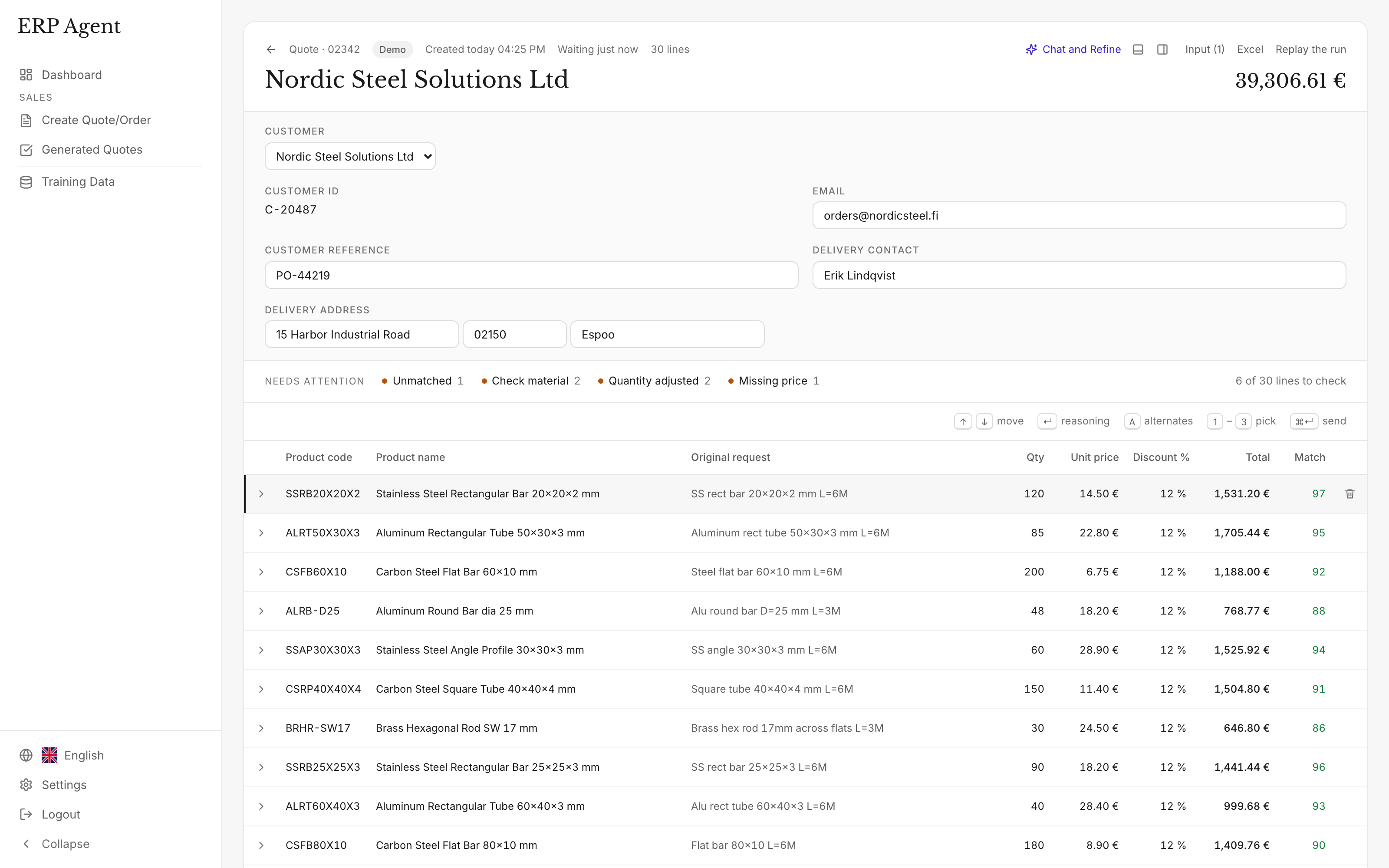
All of this happens in ERP Agent’s review screen, and every step works from the keyboard.
The draft fills in while you watch
Lines appear in the table as the agent matches them. Requests with several hundred lines are split into batches that run in parallel.
Go straight to the marked lines
Every line carries a match score from 0 to 100. Press N to jump to the next line under 80. The customer’s original wording sits next to the proposed product, with the agent’s reason for choosing it.
Swap with one key
When more than one product could fit, the line already stores up to three runner-ups, each with its own match score, unit price and line total. Press 1, 2 or 3 to take one, 0 to go back to the agent’s pick, or A to search that line again.
Change the rest by typing
In quote chat, type “line 4 should be the 230 V version, and add 10 wall plugs”. The agent searches your catalogue and shows each change as before and after, such as “#4 unit price 7.49 € → 7.95 €”. Keep or reject each one. The chat cannot send anything.
Send, and it learns
Send to your ERP with “Final — send and learn”. The next time a customer writes the same thing, the agent picks the same product. Nobody writes a rule.
Example: an enquiry in the customer’s own words
A contractor emails a plumbing and drainage merchant. Prices are left out here; in a real draft they come from your company’s pricing.
“Please quote the below for the Harlow site, delivery week 44.”
- 20 x 110mm soil pipe 3m
- 6 x ball valve 1" PN16
- 2 x inspection chamber 450 dia
- 10 x our ref DR-450
| Request line | Proposed product | Qty | Match | Note |
|---|---|---|---|---|
| 110mm soil pipe 3m | Soil pipe 110 mm, 3 m | 20 | 94 | Size and length read from the shorthand. |
| ball valve 1" PN16 | Ball valve DN25 (1"), PN16 | 6 | 91 | The PN10 version contradicts the stated rating and was pushed down. |
| inspection chamber 450 dia | Inspection chamber base Ø450 | 2 | 71 | Marked: depth and outlets not given. The deeper base is alternative 1, one keypress away. |
| our ref DR-450 | Chamber cover and frame Ø450 | 10 | 98 | The customer’s own code, learned from an earlier quote and shown on the line. |
Illustrative example with sample products, codes and scores, showing what the review screen explains on each line.
Why the product decision is the part that matters
Reading the fields off a PDF is the easy half of a quote request. The slow half is deciding which of your products each line means when the customer writes shorthand, gives dimensions in their own format or uses their own article number. According to our case study, a sales rep spends on average 4–7 minutes per line when creating quotes and orders by hand (calculate your cost).
In a wholesaler’s product file, sizes, ratings and finishes often sit in the product name rather than in separate fields, and customers write them differently again. ERP Agent works from that text as it is. It makes the decision for every line, shows how sure it is, and leaves your rep a one-key fix when it is wrong. See how ERP Agent automates quotes.
How to test it on your own requests
You can run ERP Agent on real requests before any integration work begins.
Send your catalogue
The product file you export today is enough to start; past quotes help it learn faster.
Forward real requests
Your company gets its own agent mailbox. Reps forward customer requests there or paste them into the web app, and a typical request is ready for review in 3–8 minutes.
Count the lines that come back right
Include the difficult requests: long lists, scans, shorthand and steel lines given by cut length. Our pilot checklist shows how to set up a fair trial.
Connect your ERP
We set up the connection to your ERP or CRM during onboarding. Reviewed quotes and orders then land in the system your team already uses.
ERP Agent in numbers
- 4–7 min
- per line when quotes and orders are created by hand, according to our case study
- 95%
- average automation across our customers
- Over 95%
- accuracy in quote-line automation at LVI-WaBeK
- 3–8 min
- for the agent to prepare a typical request
ERP Agent is live with steel, HVAC and fastener distributors. Read how LVI-WaBeK turns customer requests into quote lines with the right products and prices.