On this page
Five differences you can check in a demo
- A 60-line request in one draft. Microsoft’s FAQ for the Sales Order Agent says it “supports the creation of up to 15 item lines per sales document” and that “increasing the number of lines might result in lower-quality output.” ERP Agent splits a request of several hundred lines into batches that run in parallel, and the lines appear in the review table as they are matched. A typical request is ready in 3–8 minutes; one of several hundred lines takes about half an hour.
- The customer’s shorthand, matched to the catalogue you have. Microsoft’s FAQ says that “using cryptic abbreviations versus friendly names can reduce output quality”, and its overview recommends “enhancing descriptions, attributes, categories, and extended text” of your items. ERP Agent starts from the catalogue file you already have and reads the words the customer wrote: “spiral 250 3m galv” is a Ø250 spiral duct, 3,000 mm, galvanised. When a line says EI60, 230 V or DN50, products rated EI30, 24 V or DN40 drop down the list.
- Two products could fit, and the draft is still complete. Microsoft’s overview says that when “more choices are available, the agent engages in multiturn email conversations to clarify the request.” ERP Agent decides the line and keeps the runner-ups: up to three products from your catalogue, each with its own match score, unit price and line total. Your rep opens the line and presses 1, 2 or 3 to swap, or 0 to go back to the agent’s pick, and A runs a fresh search for that line. One key instead of an email round with the customer.
- A line you don’t carry stays visibly open. Microsoft’s process page lists a known case for some local versions: “Searches for related consumables often return the main product instead of the requested accessory or consumable.” Its example is a request for washing powder that isn’t in the item list, answered with the washing machine. ERP Agent puts a line it can’t match on your company’s placeholder code instead of a near-miss product, so your rep sees an open line to decide, not a washing machine on the quote.
- The fix carries over to the next request. Microsoft’s guide to supervising agents says the instructions you give the agent “apply only to the current step. They aren’t saved or reused for future tasks.” In ERP Agent, your rep sends the quote with “Final — send and learn”. The next time a customer writes the same thing, the agent picks the same product. Nobody writes a rule.
Sales Order Agent vs ERP Agent, side by side
The Sales Order Agent column uses Microsoft’s own Business Central documentation: the Sales Order Agent overview, setup, process and FAQ pages, the guide to supervising agents and the page on consumption-based billing.
| Business Central Sales Order Agent | ERP Agent | |
|---|---|---|
| The request has 60 lines | Supports up to 15 item lines per sales document; more lines might lower output quality | Several hundred lines, split into parallel batches; lines appear in the table as they are matched |
| The line says “spiral 250 3m galv” and has no product code | Cryptic abbreviations can reduce output quality; the advice is to enhance item descriptions, attributes, categories and extended text | Reads size, length and finish from the line, checks stated ratings such as EI60 or 230 V, and scores the match 0–100 |
| Two products could fit the line | Clarifies the request with the customer in a multiturn email conversation | Up to three ranked alternatives on the line, with price and line total; keys 1–3 swap, A searches again |
| The customer asks for an item you don’t carry | Known case in some local versions: a consumable search returns the main product instead | The line goes on your placeholder code, so it stays visibly open |
| Your rep corrects the agent | Instructions apply only to the current step and aren’t saved or reused for future tasks | “Final — send and learn”: the next time a customer writes the same thing, the agent picks the same product |
| A Swedish request against your Finnish item descriptions | Mixed-language input might give lower-quality output, because the system relies on pure string similarity | Matches a request in one language against a catalogue in another |
| The customer sends the list as an Excel file | Attachments read: PDF, PNG and JPG, with PDFs up to 50 pages | Excel, CSV, Word, PDF (scanned too), images and forwarded .eml or .msg emails |
| A rep forwards the customer’s email to the agent | Contact lookup uses the forwarder’s address; a user links the right customer by hand with “Use another contact once” | Identifies the customer from the request itself and warns when no customer matches |
| “10 pcs 40x40x3 tube 2.5 m”, and you sell 6 m lengths | Quantities might need correcting when non-base units of measure differ from the standard ones | Converts length lines to kg, m or pcs, detects the standard length and adds a cutting line when the cut length differs |
| How it is billed | Copilot Credits for each step, such as 2 to analyse an incoming email and 5 to create or update a quote; out of credits, the agent stops processing new emails | A monthly subscription set by line volume alone, with unlimited users; quote requests, tenders and sales orders always included. Plus a setup fee, itemised before you start (pricing) |
What your rep does with a 40-line request in ERP Agent
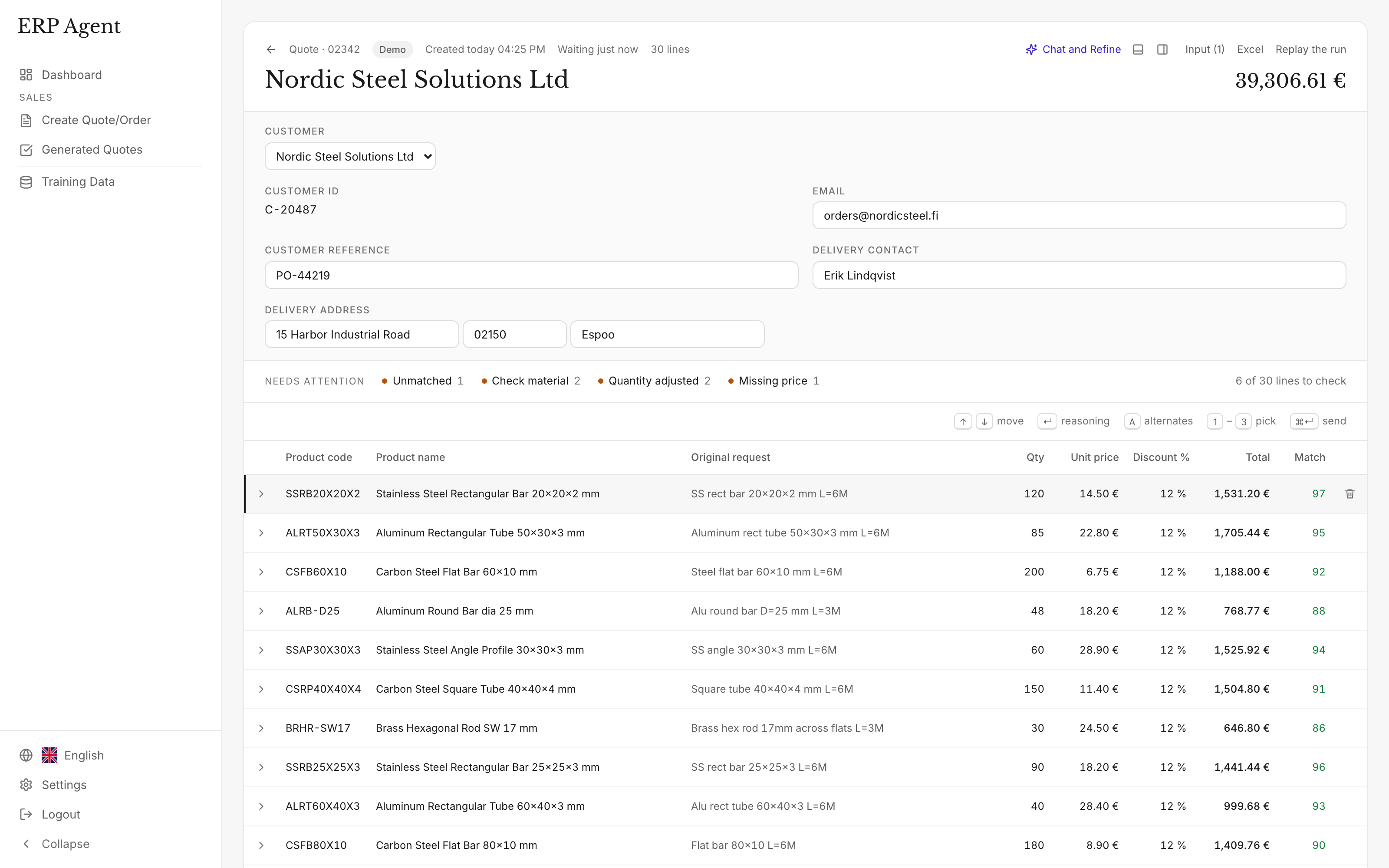
All of this happens in one review screen, and every step works from the keyboard.
The draft fills in while you watch
Lines appear in the table as the agent matches them. Requests with several hundred lines are split into batches that run in parallel.
Go straight to the marked lines
Every line carries a match score and the agent’s reasoning. Press N to jump to the next line under 80. The customer’s original wording sits next to the proposed product.
Swap with one key
Press 1, 2 or 3 to take a stored alternative, and see the new price and line total at once. Press A when you want the agent to search that line again.
Change the rest by typing
In quote chat, type “line 4 should be the 230 V version, and add 10 wall plugs”. The agent searches your catalogue and shows each change as before and after, such as “#4 unit price 7.49 € → 7.95 €”. Keep or reject each one. The chat cannot send anything.
Send, and it learns
Send to Business Central with “Final — send and learn”. The next time a customer writes the same thing, the agent picks the same product.
Example: five lines from a 60-line enquiry
Five lines from an illustrative 60-line enquiry to a heating, plumbing and ventilation merchant: four times the 15 item lines Microsoft documents for the Sales Order Agent. Prices are left out.
“Quote please for the attached, delivery to site in two weeks. Our usual terms.”
- 40 x 22mm comp elbow
- 12 x Ø250 spiro bend 90
- 4 x fire damper 600x300 EI60
- 4 x 24V actuator for above
- 10 x our ref HV-2214
| Request line | Proposed product | Qty | Match | Note |
|---|---|---|---|---|
| 22mm comp elbow | Compression elbow 22 mm, brass | 40 | 95 | “Comp” read as compression. |
| Ø250 spiro bend 90 | Spiral duct bend 90°, Ø250 mm, galvanised | 12 | 92 | “Spiro” read as spiral duct; diameter and angle match. |
| fire damper 600x300 EI60 | Rectangular fire damper 600 × 300 mm, EI60 | 4 | 88 | Size and fire rating checked; EI30 and EI90 dampers pushed down. |
| 24V actuator for above | Damper actuator 24 V, spring return | 4 | 76 | Marked: return type not stated. The 24 V actuator without spring return is alternative 1, one keypress away. |
| our ref HV-2214 | Wall sleeve Ø160 mm, insulated | 10 | 97 | The customer’s own code, learned from an earlier quote. |
Illustrative example of how a draft is presented for review. Products, codes and scores are invented.
Why the product decision is the part that matters
Reading the email is the easy half of a quote request. The slow half is deciding which of your products each line means when the customer writes shorthand, gives dimensions in their own format or uses their own article number. According to our case study, a sales rep spends on average 4–7 minutes per line when creating quotes and orders by hand (calculate your cost).
Microsoft’s documentation ties that decision to your item data: exact item numbers and references first, then item attributes, then a broader search, with richer descriptions, attributes and categories as the way to improve results. ERP Agent makes the decision for every line from the customer’s own words, shows how sure it is, and leaves your rep a one-key fix when it is wrong. See how ERP Agent automates quotes.
How to test it on your own requests
You can run ERP Agent on real requests before any integration work begins.
Send your catalogue
An item export from Business Central is enough to start; past quotes help it learn faster.
Forward real requests
Your company gets its own agent mailbox. Reps forward customer requests there or paste them into the web app, and a typical request is ready for review in 3–8 minutes.
Count the lines that come back right
Include your longest and most abbreviated requests. Our pilot checklist shows how to set up a fair trial.
Connect Business Central
We set up the Business Central connection for your company during onboarding. Reviewed quotes and orders then land in Business Central, where your team already works.
ERP Agent in numbers
- 4–7 min
- per line when quotes and orders are created by hand, according to our case study
- 95%
- average automation across our customers
- Over 95%
- accuracy in quote-line automation at LVI-WaBeK
- 3–8 min
- for the agent to prepare a typical request
ERP Agent is live with steel, HVAC and fastener distributors. Read how LVI-WaBeK turns customer requests into quote lines with the right products and prices.